
Some months ago I got a broken Mettler AE260, electronically working but with shipment damage on the display cover (it is actually made of real mineral glass) and the Tare bare, which is just fixed by thin plastic flexure.
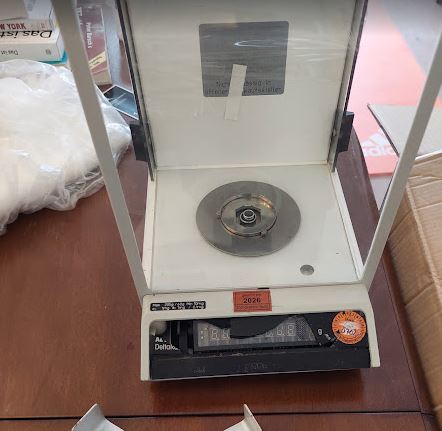
Checking it quickly, there is fortunately nothing wrong with the inner flexures and hinges, all good. On top of the mechanism, like for all Mettler AE balances, there is the electronics board. These look the same for all balances, but have some differences in the detail design and programming of the CPU.
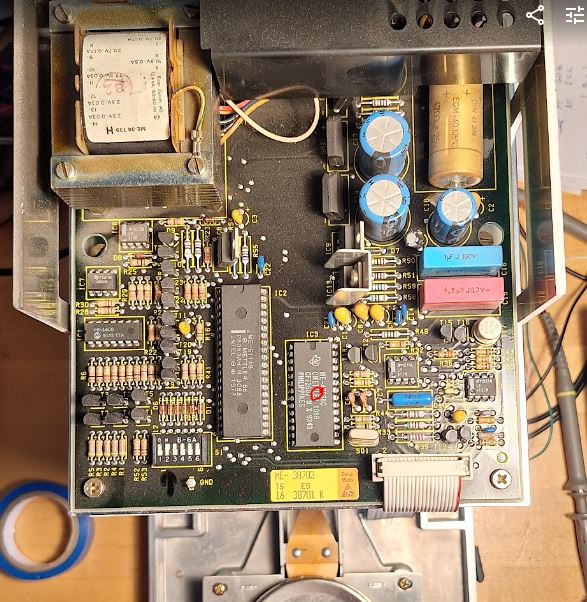
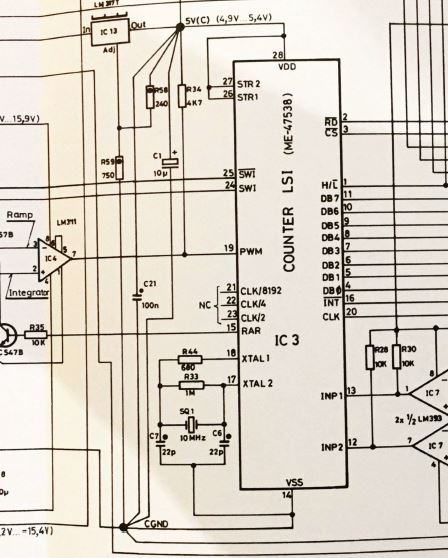
I ever had the interest to analyze the raw data of such balances, say, to directly read the signal without any internal filtering. All these balances have a counter ASIC, and by reading the schematic carefully, I figures out the data bus and general data transfer process to the CPU.
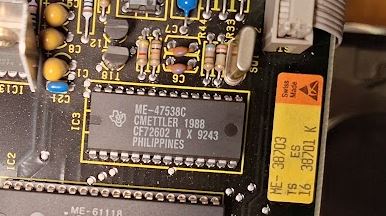
First I thought I need to attach wires directly to the timer IC, but as it turns out, the data bus and necessary signals are available at the interface connector, accessible at the back of the balance.
Just needed to attach a latch and some buffers to listen to the data sent from the counter to the CPU.
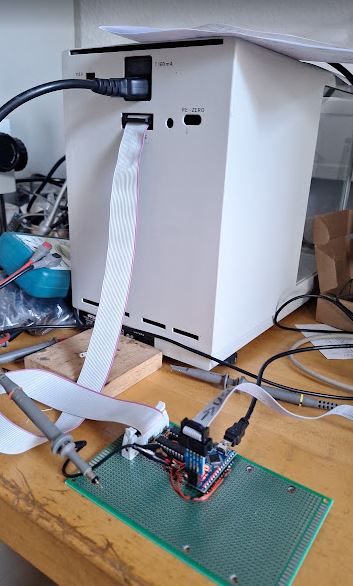
A small AVR microcontroller is used to translate the signals to numbers, provide some data reduction by averaging for 1000 counting events which is approximately a 0.5 Hz data rate. Each primary counting interval is about 2 ms. That’s why a 16 bit counter will be sufficient – with the 10 MHz clock, it won’t overflow with a maximum of 20000 counts.
For the test, I installed the balance at the most quiet piece in my basement, on a solid concrete foundation but with no other noise isolation or any table in between.
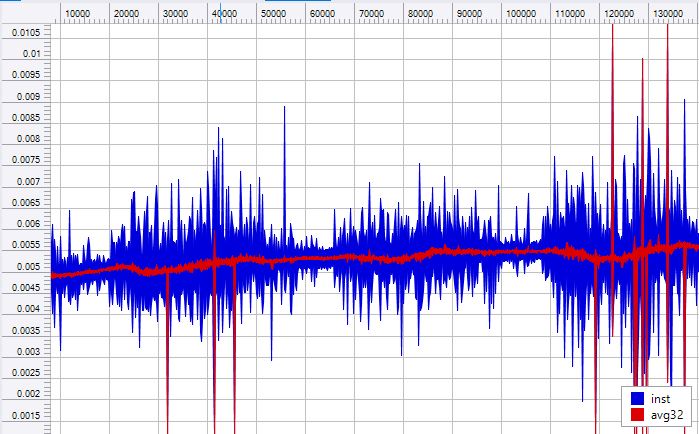
Collecting data for several days, and analyzing these as the directly collected data (blue trace), and a 32-average mean value, there is some clear pattern visible: day and night differences in the background noise. So at least we know that the balance mechanics are not the limiting factor, but rather the background noise.
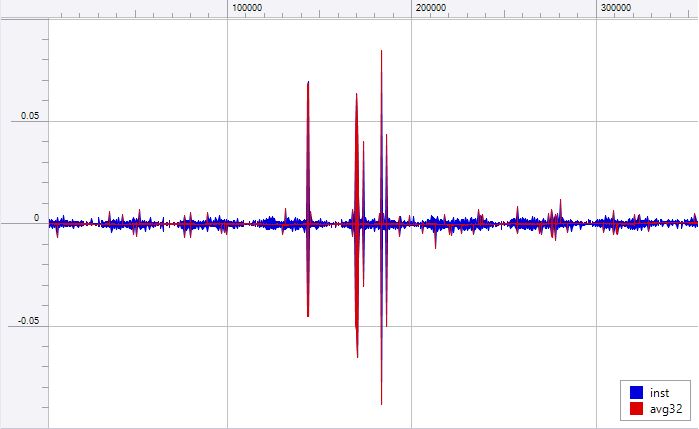
When looking at the data in some detail, it is also obvious that advanced filtering will be needed to get 0.1 mg resolution with stable reading.
Right halfway through the test period, my 2nd-next neighbor decided to work on his pool with a big excavator, causing all kinds of disturbances visible in the data. Other disturbances are cars passing by. I am living in a rather quiet neighborhood, but during weekdays there is some traffic. Also, a train line is not that far, and appears to contribute to the underground noise.
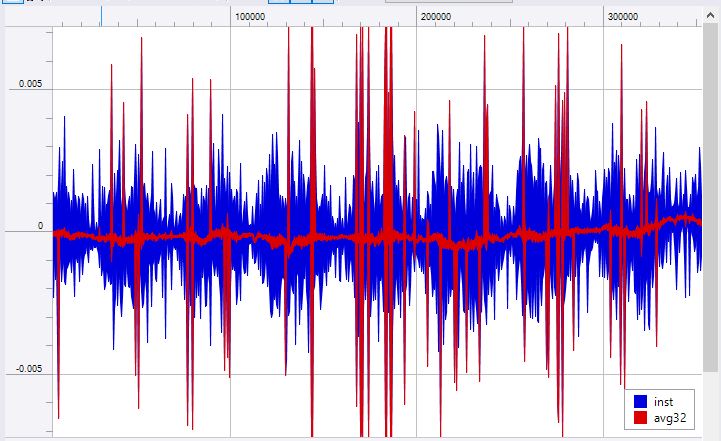
Drift is pretty good, hardly drifts a fraction of a mg per hour, and there is no persisting drift. I also have a temperature probe in the balance, a DS18B20 one-wire thermometer, but the basement temperature was rather stable, and no correlation or temperature-related drift could be found. Note that the balance circuit has internal temperature compensation in hardware, set at the factory by certain programming resistors.
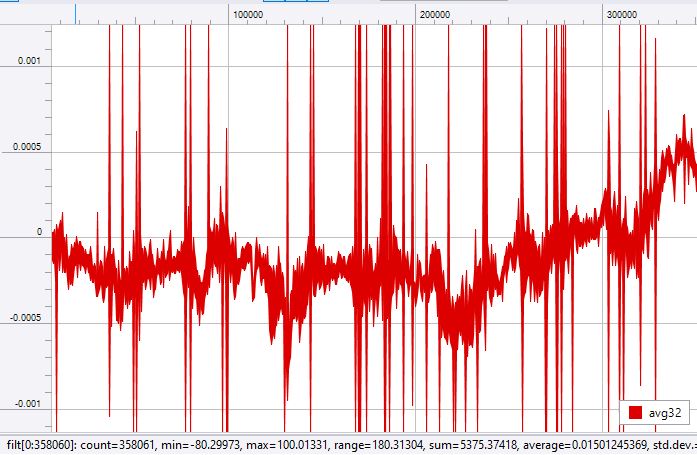
Same situation with a 100 g weight applied. Probably this balance can be a good seismic sensor…
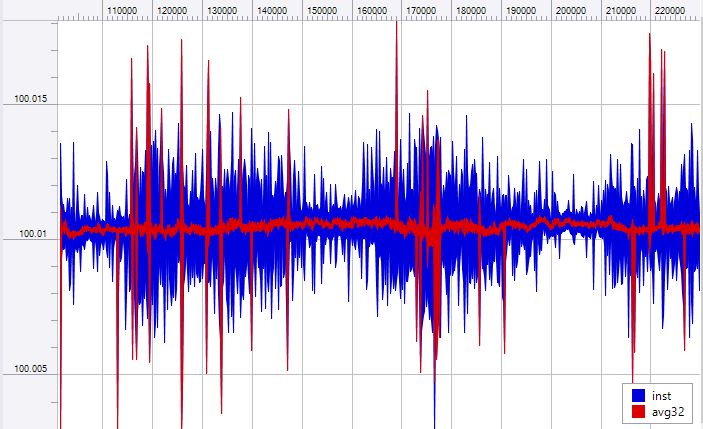
Sunday are especially quiet, also during the day, you see much less noise. Probably, because there are few heavy trains moving, and no trucks, no deliveries.
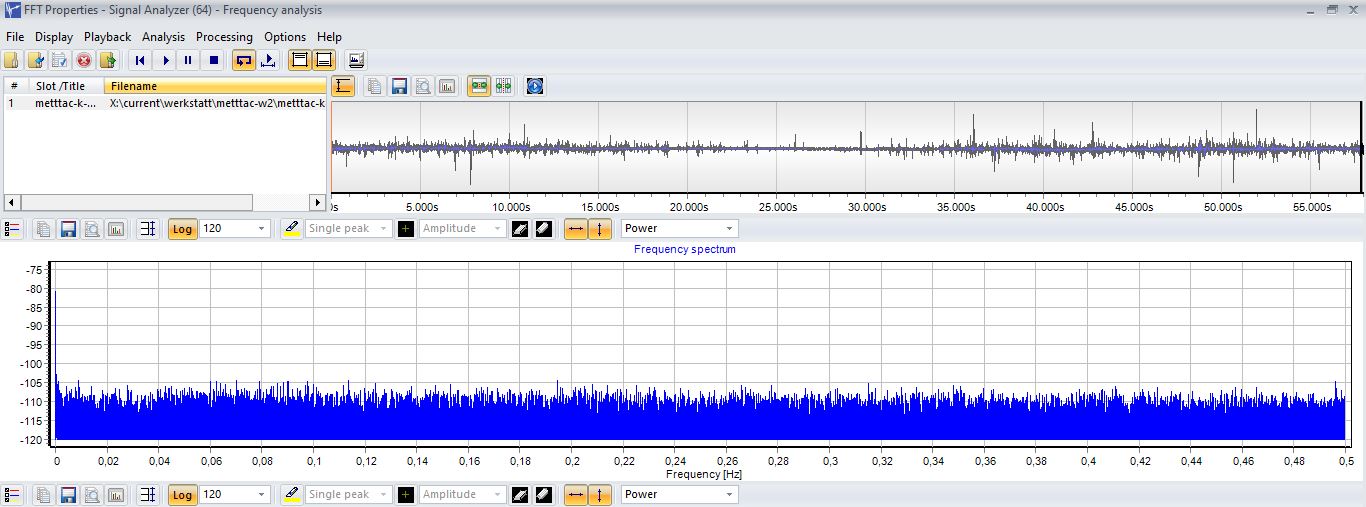
Analyzing the spectrum of the noise data, it appears to be white noise, without any particular spectral component sticking out or a dominant disturbance at a certain frequency.
I have also done quite extensive linearity checks, more about that later.