Category Archives: Ancestry

The Family Chronicles: Linoprint cover page

With the chronicles related to my father’s parents completed, and the book decorated by hot embossing (see: The SCHRÖDLE Family Chronicles: decorative hot embossing) it is time to consider the decoration of a similar book about the parents of my mothers. Fortunately, the contents are nearly complete, but I didn’t want to do just another hot embossed front page. After some brainstorming, woodcut print seemed like a nice idea. Surely, I have no time and patience and skill to cut a complex plate from wood with knifes, but intended to use a digital design and than LASER-cut it into the material to general a relief suitable for printing.

First I tried to use actual wood, but the results were not that nice with ordinary plywood. The edges break off easily with thin elements.
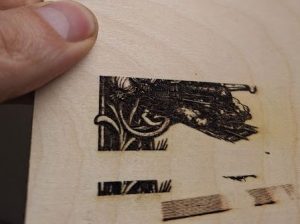
Cutting is easy, I am using a Sculpfun S9 cutter with a blue diode LASER. The material is held to a metal plate with some magnets, there is no further workholding needed. Compressed air is used to blow away the dust and to protect the laser optics. All the fumes are extracted by a fan to an exhaust – the whole LASER cutter is in a protective enclosure..

After seeing the mixed results with wood, quickly ordered some “art supplies”, good old natural linoleum (don’t get the PVC type, this cannot be LASER cut and will emit toxic fumes!). Linoleum plate is made from linseed oil, wood powder, limestone filler and some additives. Just a few days later, two plates arrived. There is a very nice and particular smell of fresh linoleum in the workshop.

Before going to the endeavor of large format prints, good to start with some smaller test piece. Because of the thin beam, the engraving works best here at 10 lines per mm, 1300 mm/min speed. After a few minutes of engraving, a small cat relief was ready. The raw cut needs some treatment to remove the burned residues. First tried with an eraser, works well, but eventually a good method is to bead blast it with compressed air.

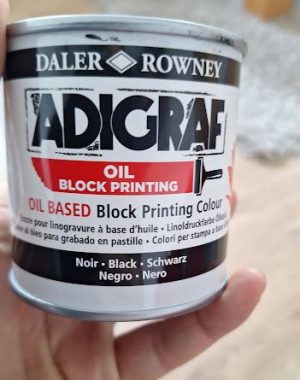
There are two kinds of paints, water and oil based. Water based paint has the advantage of fast drying and easy cleaning, but for the traditional look and ever-lasting persistence, oil based paint is preferred. After doing some research, the DALER-ROWNEY ADIGRAF seemed to be a good choice. A 250 mL can is just about 10 EUR and will last for many prints.
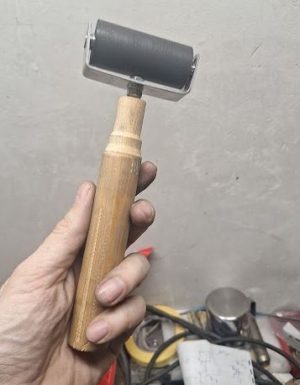
Next, we need a rubber roller. Using some piece of an old typewriter, cut to size and turned down to a little smaller diameter on the lathe, and with a simple wood handle attached, a sturdy roller was fabricated quickly.
The cut linoleum relief is stuck down to some old chipboard, and the printing setup is ready.
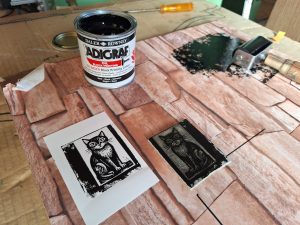
To my greatest delight, the first print turned out well. A lovely cat print. Just used my fingers to transfer the ink by circular motion.
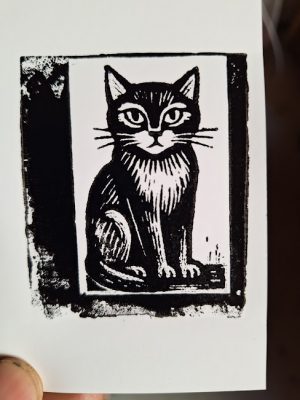
The cat motive is good for experimenting: the quantity of ink, the uniformity of ink application, attaching the paper, transfering the ink, all needs some practise.

With many cats printed, it is time to engrave the big relief for the book cover page. The artwork went through quite some iterations, because I wanted to incorporate motives from my ancestors’ past, without it looking to fancy. Giving it a little worn and historic look, with simple elements. A certain variability of the ink application will give a nice individual touch.
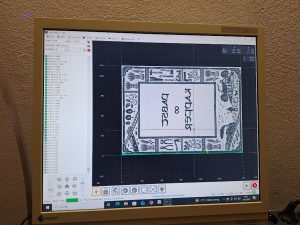
The engraving took about 3 hours. Not fast, but for a very affordable 5.5 Watts LASER, fair enough.
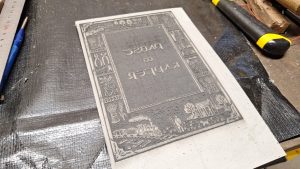
Cleaned it out by bead blasting (soda glass beads of ~300 µm at 8 bars), and some manual work to cut it out with some tapered edges.

After the cat exercise, inking the relief worked pretty well and the first print gave a good result. Switched form 150 g/m2 paper to hard 250 g/m2 board to give the book some stiffness.
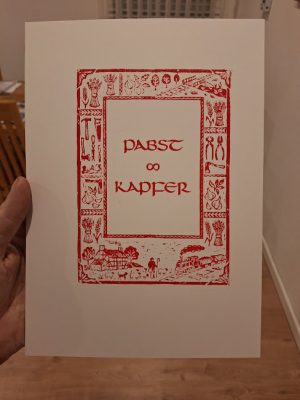
In no time several prints were made.

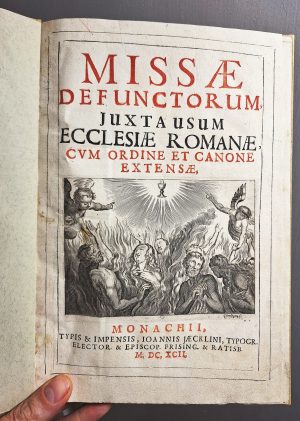
While the deep red color is a nice, it is lacking a little contrast. From very old books, like this copy from 1692 (which is one of the oldest in my library), a black-red color scheme is known, which has been also used for woodcut prints and similar, for example, for “ex libris” cards and other more art-oriented printing.
For inking, a small roller was needed. Rather than buying one, made it myself, this time from some paper pushing roller of an old printer (good that I keep a large assortment of parts in my basement…).

With a piece of steel wire, the small roller (also called a brayer) is ready for use.
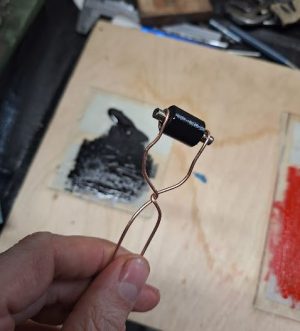
To roll-out the ink to a thin layer, some pieces of old glass sheet attached to a wooden board are hand, because of their smooth surface and resistance to solvent cleaning (methylated spirits are good for cleaning of the oil based ink).

The inking is about three times the effort compared to a single-color print, but at least we don’t need to worry about the alignment of the paper when all two colors are printed at one, rather than consecutively.

The result turned out well, such a nice contrast of red and black!
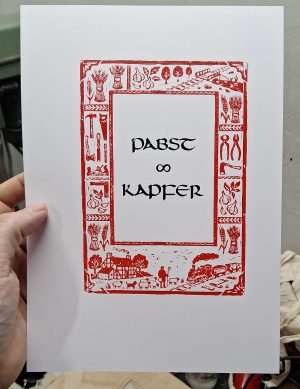
Now, many prints have been made, and these need to dry thoroughly, which will take at least 5 days, better 2 weeks, for the oil based ink.

The SCHRÖDLE Family Chronicles: decorative hot embossing

The major project besides all the work in the electronics lab and mechanical workshop here has been the writing of the family chronicles and ancestry research, starting with my father’s side: the grandparents SCHRÖDLE and REITSAM. Now as the draft has been completed, I have put further thought to the publishing. The specialized contents won’t justify a large printing operation with many copies, so the book will be done by digital print rather than professional offset printing. Also, there may be some corrections necessary after the first print, therefore I don’t like to print to many pieces that then need to be corrected, but will only print the copies needed. Binding will be done by a spiral binding machine that I have recently purchased used, a heavy-duty version of a spiral binder that I have owned for years to make small “user manual” booklets and similar.
For the cover page, I thought it is a good idea to not only print it black and white, but to give it some nice appearance by gold print.
Golden letters can be printed by various means, but the best result is obtained by hot embossing. A heater metal (or special polymer stamp) is pushed into the paper, with a hot printing foil in between. The foil has multiple layers: a PET carrier, a layer of gold-colored aluminum, and a heat activated glue. Where heated the the embossing stamp, the foil will stick to the paper and the gold layer will transfer to the paper when the hot print foil is peeled off.

While the theory is easy, the challenge is to do the hot embossing in the home shop without a specialized machine. I have some experience with milling brass stamps that I have made for some friend years back, CNC milled. But with current case, I would need a 90×50 mm brass block, which I didn’t have in stock, so I took some hard aluminum alloy instead. Durability is no issue anyway, because I will need less than 100 copies anyway.

After preparing the stamp block (it will be directly heated by two 180 Watts 230 Volt heater cartridges, 10 mm diameter, 80 mm long), I set it up on my CNC mill to cut the letters. Don’t forget that all must be mirrored!

The program has many lines, but all no problem with LinuxCNC, which can handle machine programs of essentially any size.

First, roughing out the main parts, with a 3.8 mm endmill, 1.5 mm deep. You could also use a 2.5 mm endmill, but from experience, it is ok to just mill away the major gaps and cut the other areas by am engraver tool.

The fine engraving is done with an approx. 60 degrees engraving single-lip cutter. Surely, my CNC’s spindly is not fast enough for this, using about 2800 RPM where I should run at 10000, but the feeds were adjusted to roughly 140 mm/min, to get away with the “slow” rotation. The single-lip cutter (made from K30 tungsten carbide) is holding up well in hard aluminum and leaves a shiny cut even without any lubricant.

For a test print, I heated the metal stamp on a hot plate. It has some crude temperature regulation, so it is not difficult to control the temperature.

The supplies prepared: some pieces of paper (always use the actual paper you want to print on), some cut strips of heat printing foil (this foil I have purchased more than 20 years back, a mid-sized coil, many meters because it is petty thin), and a thermometer to sense the temperature of the block while heating (the green wire is the thermocouple).

The printing itself, I did on the print press. It is recommendable to print on a piece of thick paper or cardboard, to have a certain depth of the impression. You can also print on a flat and hard surface, but the result is then less impressive. Temperature, pressure and time need to be established by trial and error, say, 180-200 degrees centigrade, intermediate force, and just a few seconds are a good starting point. Too hot printing will damage the foil and paper, too cold printing will give bad transfer and low durability, too high pressure will give unclean corners and edges, and too long printing will result in transfer to areas that are not letters, leaving a “dirty” print. You can check with an eraser: a good hot embossing will not be affected by using a soft eraser on it. If the gold comes off, either the paper is not good, the temperature is too low, or you are not pressing hard enough.

At an angle, there is a nice reflection. This is printed with a semi-matte gold foil, I will also try a shiny reflective gold foil. But I guess my grandparents would have been happy with any style of gold print.

The Schrödle Ancestry: a little time-consuming effort and investigation into local history

Recently, much of my time was occupied with serious work at the my chemical professional job, business travel and, during free time in cold winter, research into the old ancestors and forefathers. The objective being, to publish a little booklet about the “Schrödle” family (my father line) for this year’s Christmas, and one about the “Pabst” family (my mother line) for next year, say, 2026.

Already may years back, in about 1993, I did some investigation simply by interviewing and recording the recollection of relatives that were still alive at that time. Archive records were hard to come by at that earlier time. Still I was able to collect quite a bit of information up to the level of great and great-great grandparents including great-uncles and great-aunts.

I recorded this earlier work in simple diagrams. This time I wanted to set up a proper database in GEDCOM format well familiar in the field of ancestry work. Further intention was to go back to about the time of the “30-years’-war”, a critical time in German history, 1618-1648, where a lot of devastation and movements happened at my homeplace.

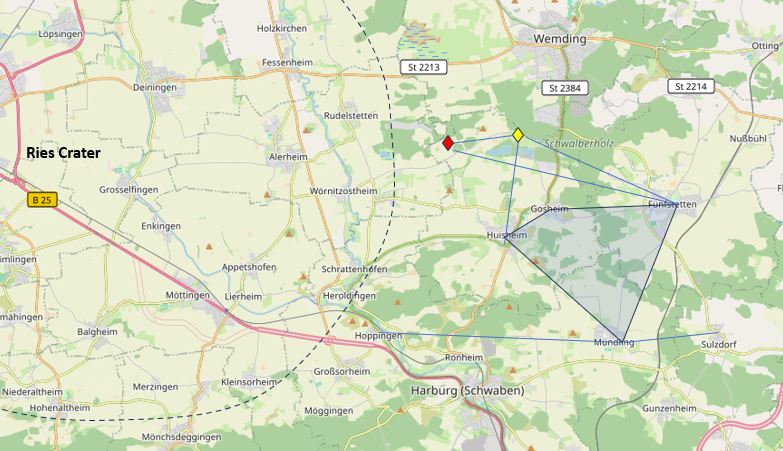
The homeplace, it is a fertile area near an ancient meteorite crater, the Nördlinger Ries. At the high rim of this crater, the Schrödle ancestors have ever been working the land as farmers, millers and craftsman. Surely busy folks familiar with the hardship of essentially self-sufficient life. Places like Fünfstetten, Gosheim, Huisheim, Mündling were the villages of the dwellings, these are very old villages, with records dating back 1200 and more years, but certainly the are in and around the crater has settled since the stone age, many famous old bones have been found.

Two reasons facilitated the new wave of ancestry research: firstly, my father’s family has ever been from this famous spot in Northern Swabia area of nowadays Bavaria, Southern Germany, the old Sualafeldgau dating back to the 8th century AD. Secondly, there are now large numbers of records online available, in particular, the old church records about birth, marriage and death. And, fortunately, these have been well-preserved over the centuries in this area.

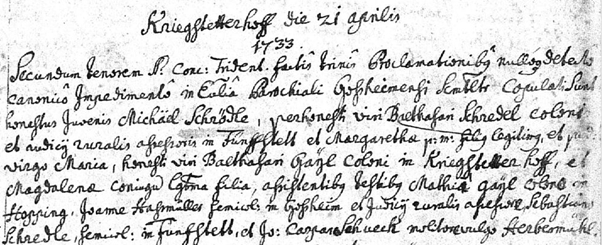
Surely, it is all a matter of patience to find the right records, assign them to the family tree and record the information in a digital format, say, a GEDCOM file. Some, like the marriage record of a son of one of the oldest Schrödle ancestors, a certain Balthasar Schrödle born in the 17th century Fünfstetten, and which is relatively easily read after some practice, and with my training of ancient latin received at school – final I can put that to some use.

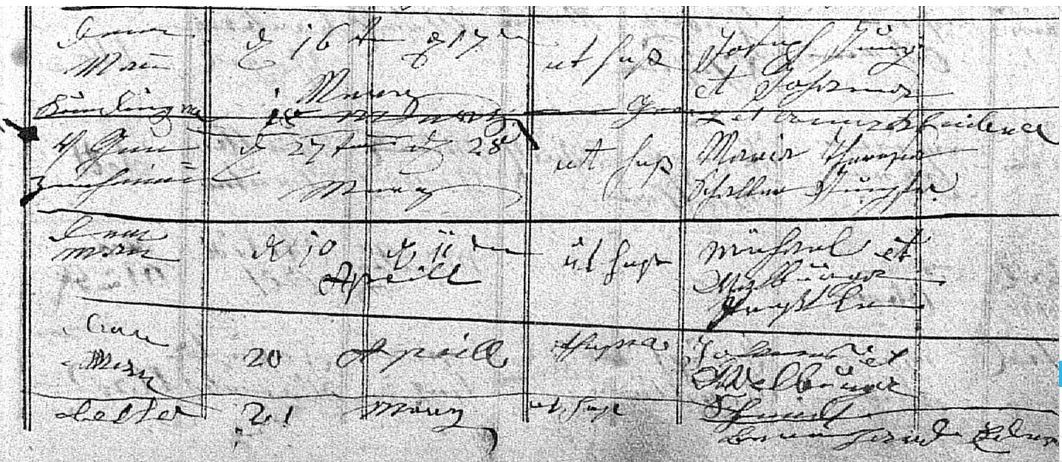
Other records are difficult to read – even relatively recent records from the 19th century, because of bad handwriting of some priests, and there lack of attention to readable handwriting.

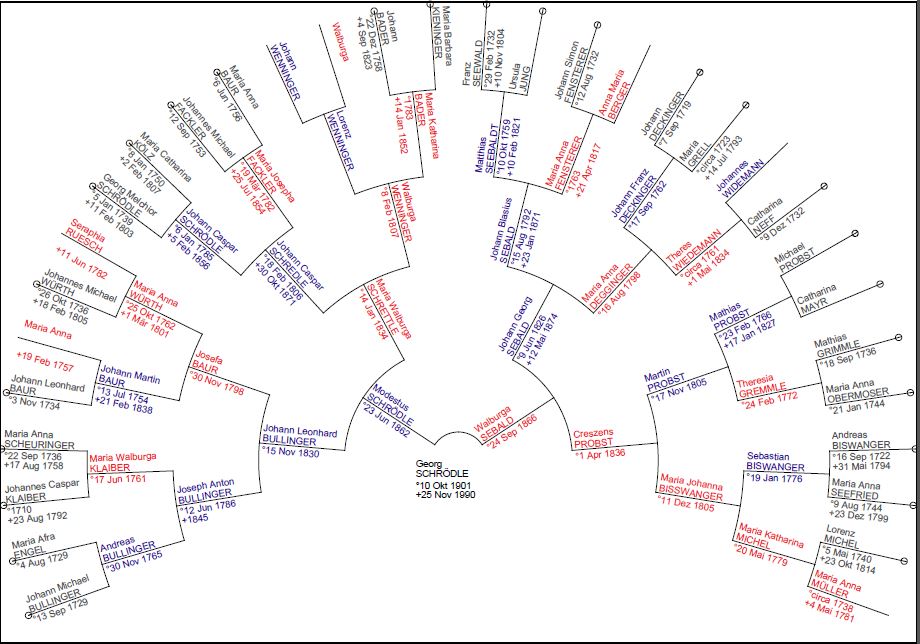
But after all, I have been able to reconstruct the family roots back many generations, here, for my grandfather Georg Schrödle, born in 1901. He was a farmer with patience, a kind man duly respected, still in good memory.

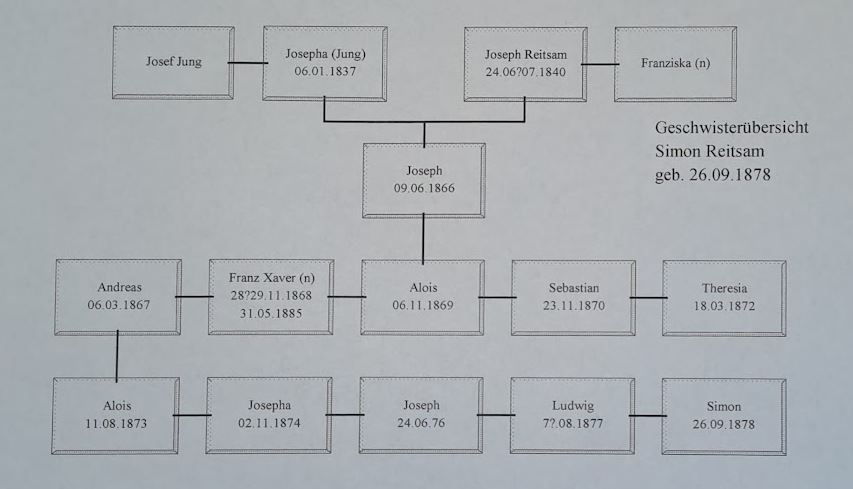
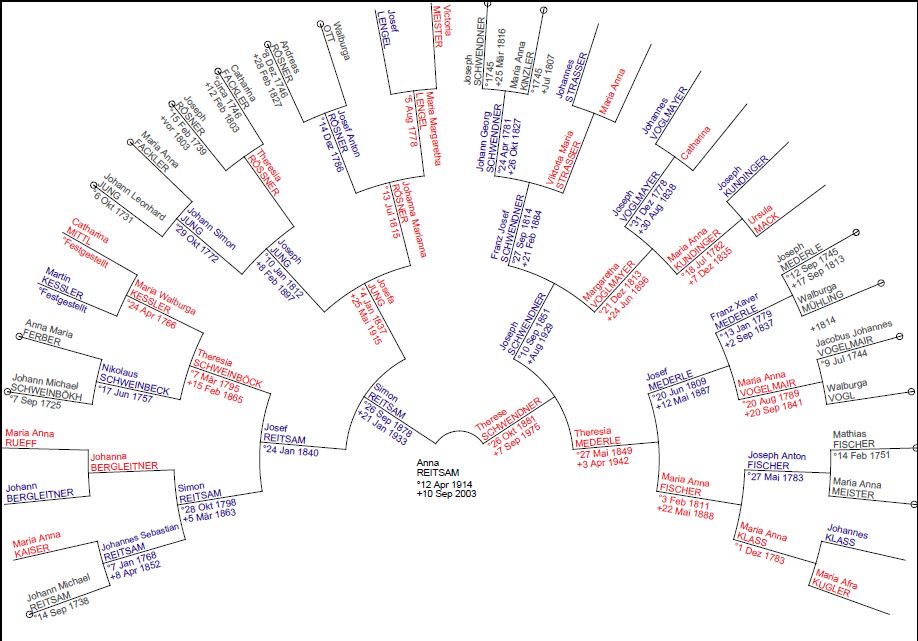
Similarly my grandmother, a descendant of the large Reitsam family in Mündling.

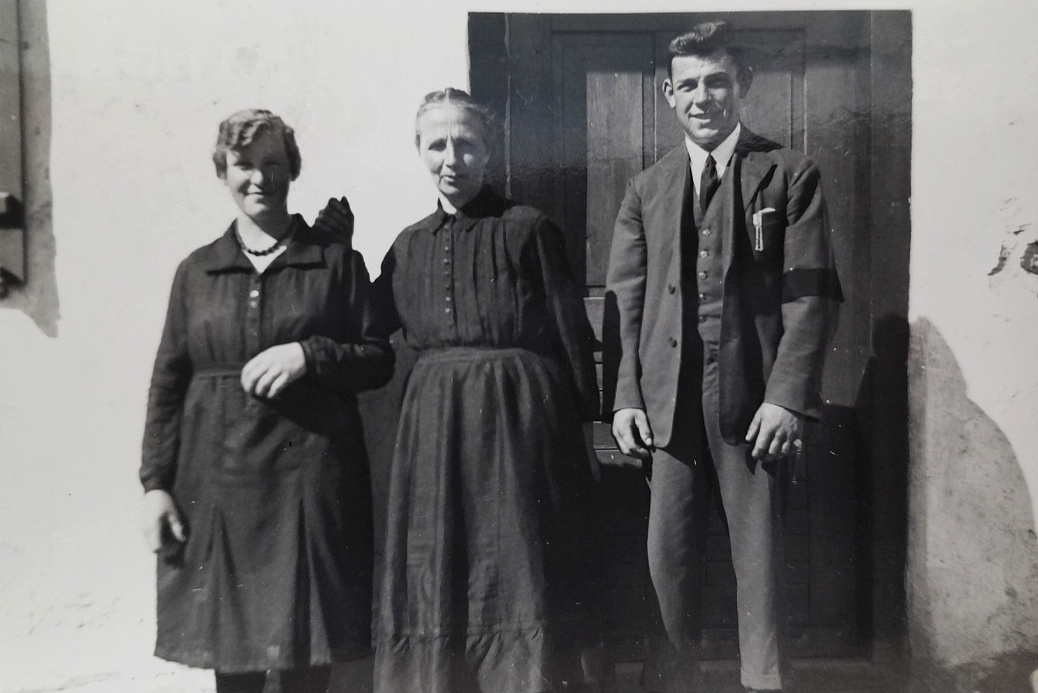
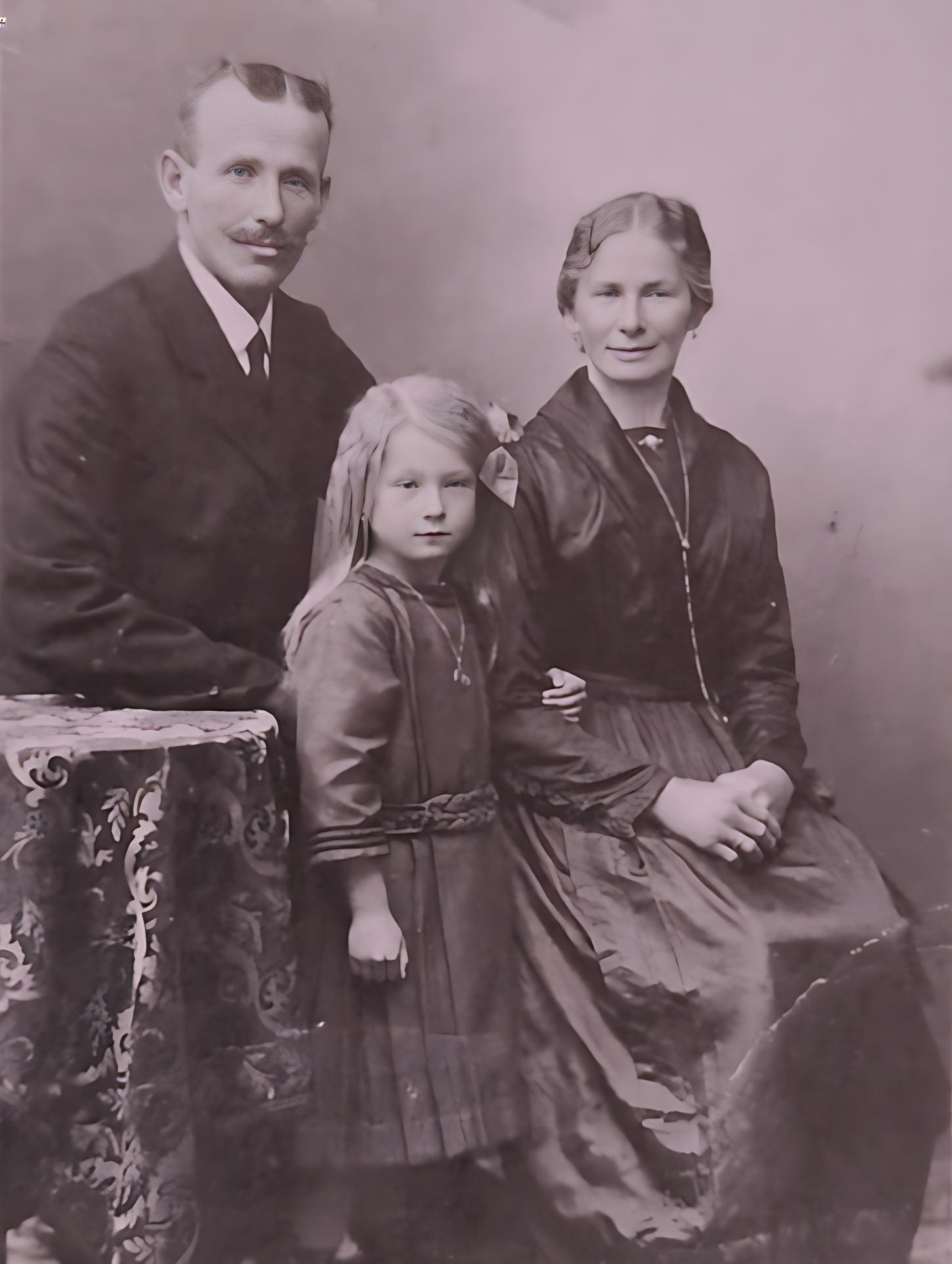
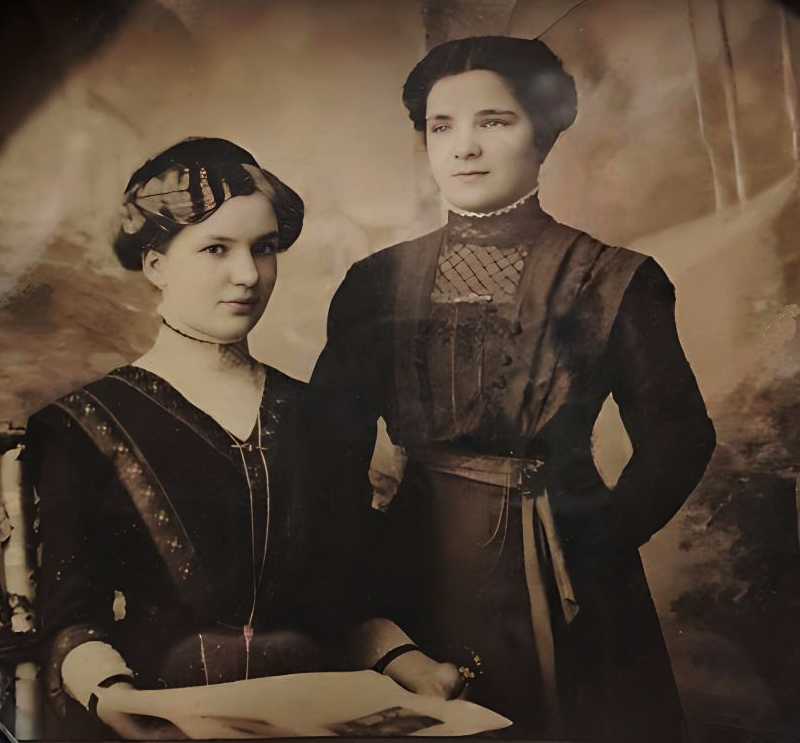
Despite all the wars and difficulties of time, some items including books, papers and photographs still remain in possession of the family, but without knowledge of the ancestry, it is hard to assign these to the right people and to understand how these objects relate to family history. Accordingly, one part of the effort is also to identify all the persons on these old pictures and documents, to avoid this information getting lost over time.

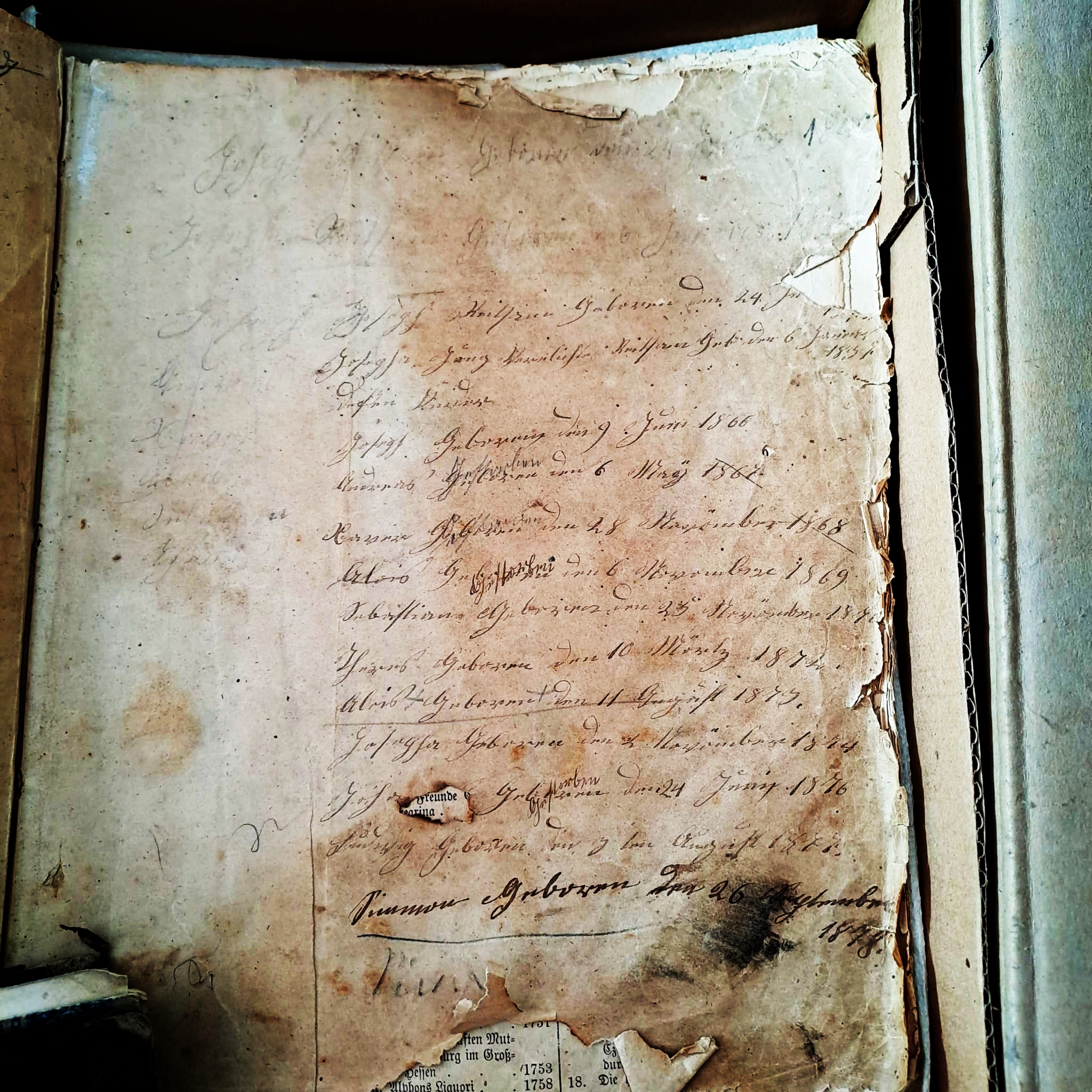
One example is a book, which was in possession of the Reitsam family, the family of my great-great grandparents. While the book itself is nothing of particular value, a history of holy people that was similar to a bible probably the only book in the possession of common people, but with hand-written notes about the family members and birthdays. The last entry, written “Simmon”, is my great-grandfather Simon Reitsam, which which I inherited my first name.

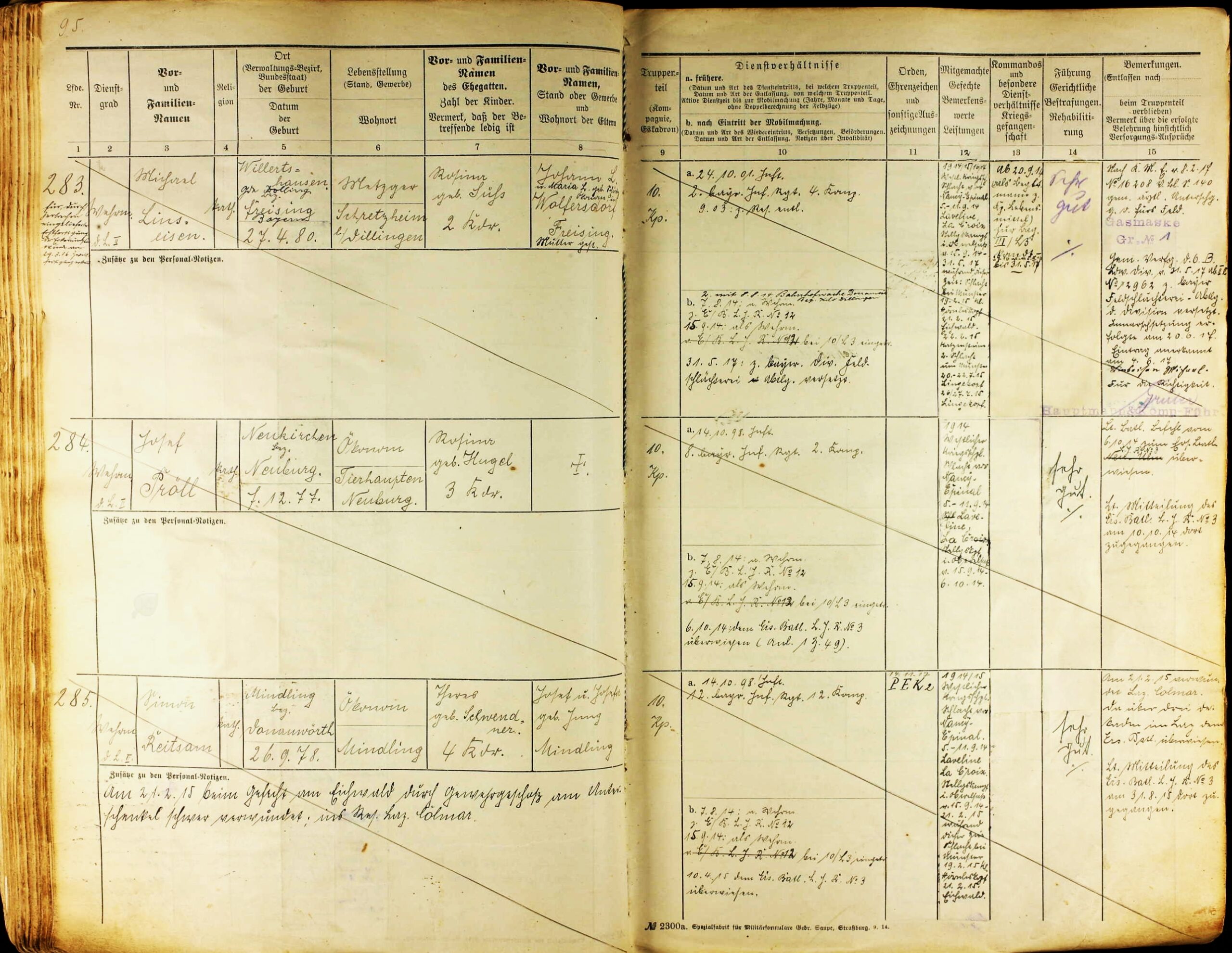
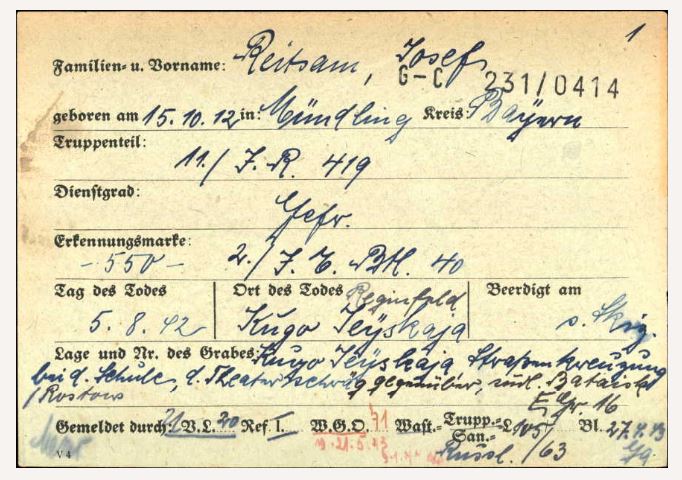
Then, with the proper birthdays and other records, I did further research to find sources in archives, also, military archive collections, and many good records could be found.

One sad thing of the more recent history is also to number of people lost to wars, for example, Josef Reitsam, my great-uncle (mother of my grandmother, father side).

After all the years and only unclear recollection by hearsay, at least we now know the exact place and circumstances of his tragic and futile death during World War I.

Many other tragic events also came up during the research, which can serve as a warning to the current day: a Schrödle child, drowned in the river feeding the Schrödle grain mill, a Schrödle ancestor, who got pulled into the gears of the mill and died, a Reitsam ancestor, a carpentor and builder, who got hit by a tree and died, many children of the old families that died of infections diseases, and so on. We can hardly imagine all the hardship of the old days, and maybe get a better appreciation of modern times and the value of peace and a society based on the advancement of science of industry. After doing a fair bit of ancestry research now, there is certainly no desire to go back to the “good old times”.

Another, much more pleasurable aspect is the number of “far” relatives, and newly-found parts of the family. There are many relatives living in the US, emigrated to Chicago and similar places. Some still carry the name Schrödle, and actually pretty close relatives. Even in the local area, there are several families, whose relationship to us has been only vaguely known or even completely unknown. If you contact some of these members to find out more about the relationships and ancestors, so far I have encountered only the most helpful and kind people, so this is really a pleasure and joy. Also there are some local historians doing research into certain places and family groups in certain villages. These, too, are the most helpful and kind people encountered.

Some examples, the Reila family related to the great-grandmother, with roots in the Huisheim Angermühle, a grain mill.

The Sebald aunts, daughters of a postman who left the farm villages to follow job opportunities in Augsburg, the largest city in the closer surroundings.

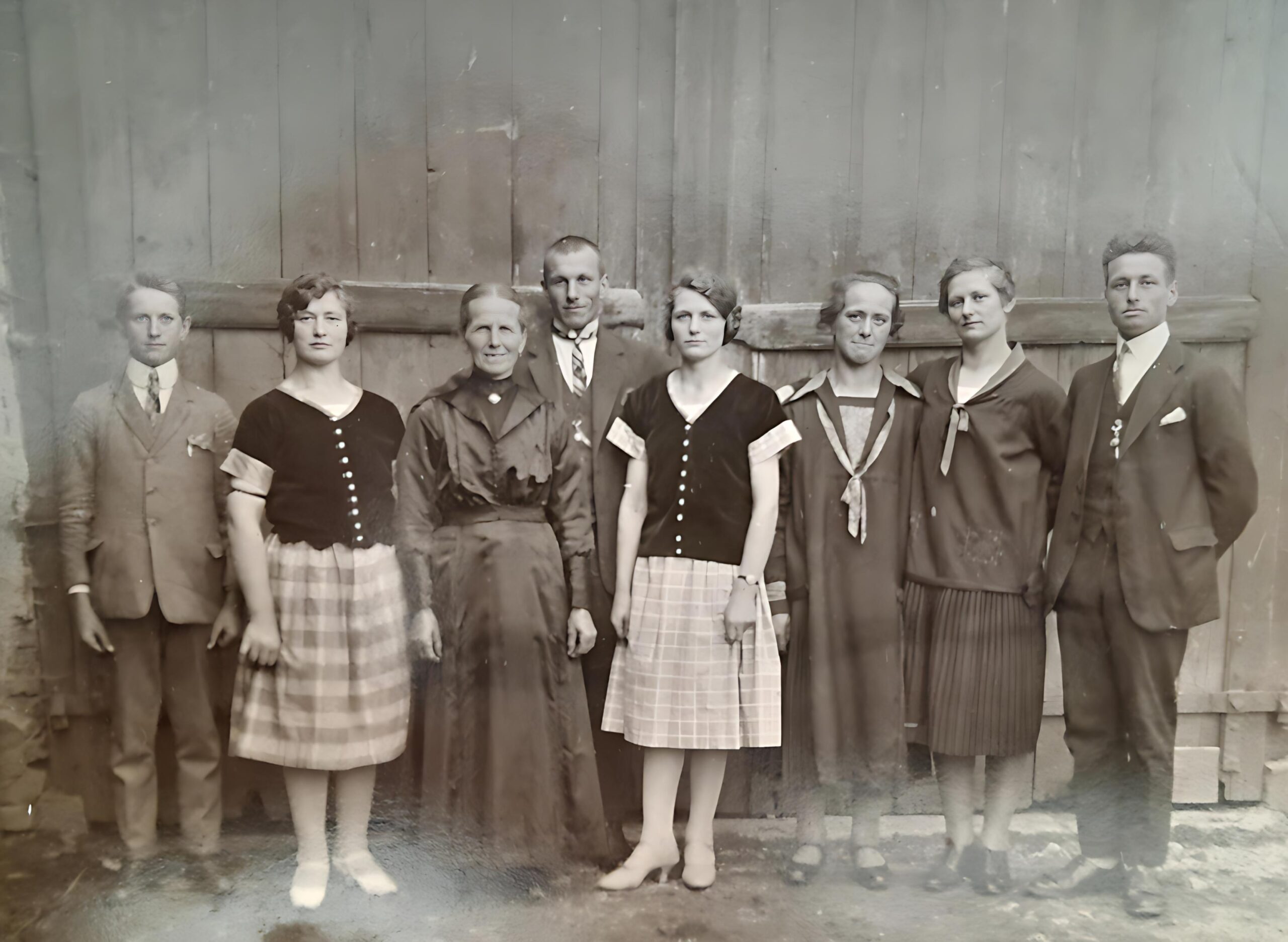
Very unexpected also the huge number of relatives related to my great-grandmother, Therese Schwendner – a kind and distant relative had a picture of here sister will all her children, dating 100 years back.

Let’s see how things will proceed over summer, with less time and more outdoor work to do.