Category Archives: Test Equipment Repairs

For some, it is like solving crossword puzzles: fixing defective test equipment. Preferably, mid-70 to early 90s vintage.

HP 8753C Network Analyzer: spare YTOs

Not giving up on the HP 8753C Network Analyzer repairs. Especially, because these units are really top class in terms of specifications and serviceability, easy to use, and well handled by GPIB bus software. Not sure why you would by and later model, if you have a working 8753C or similar model.

Some study of the YIG oscillators used in the 8753 series analyzers, while these are nothing special neither in output or tuning range (3.8-6.8 GHz, and a quick test on the source assembly shows that everything above 8 dBm seems to drive the source mixer to saturation), they have a ~23 mA/GHz tuning current, much less than the 50 mA/GHz (20 MHz/mA) of many industry standard and common YTOs. No idea why that is, a bit less power consumption, a bit less copper?

Looking around, found this marvelous Watkins-Johnson YTO, for just about 15 EURs. It was a bit dirty with wires badly soldered to it, but easily cleaned up.

Power is good, measured through a 6 dB attenuator, and pretty stable all over the range (won’t even need it up to 8 GHz).

a href=”https://simonsdialogs.com/wp-content/uploads/2020/02/8753-yig-replacement-power.jpg”>

There were no data on the power supply, so I needed to test it out. Heater voltage, seems to work well with 15 Volts, supply voltages -5 and +12 V give stable operation with sufficient margin (there seem to be internal voltage regulators).

The tuning current 50 mA/GHz, about double of the 23 mAh/Ghz of the HP YTO. So, there will be more heat dissipated, let’s do some calculations around the YTO driver. Located on the A11 board.

Clearly, the transistor will have to dissipate more heat. Do avoid any big changes, let’s adjust the current sense resistor to about half the value – resulting in about the same voltage drop per GHz.

The driver transistor, nothing special, a NPN TO-3 part, used without a heatsink.

There is no good space to fit a heatsink for TO-3 transistor, so I replaced the transistor. Used a BD245C, with amplification hfe of 40, well good enough. The SOT-93 case, it can easily be mounted on a piece of sheet metal (aluminum) to provide enough cooling.
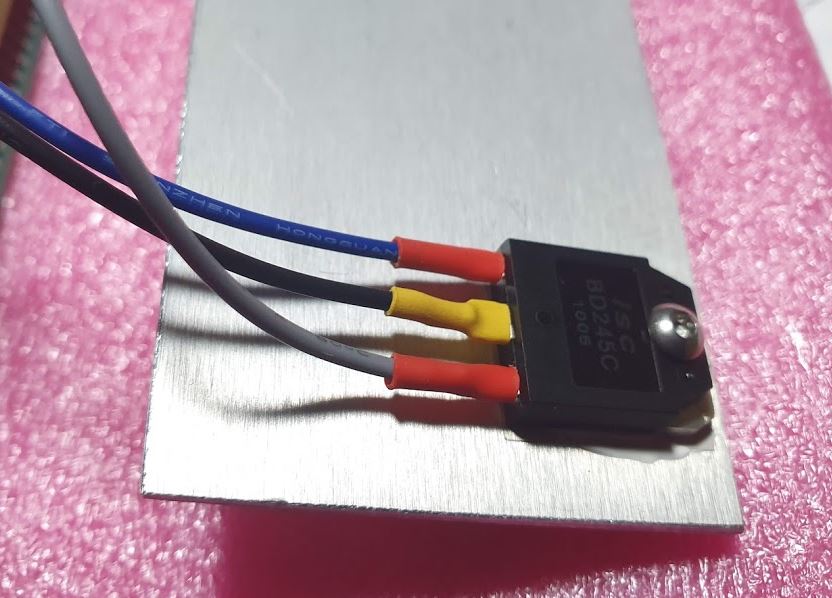
Everything well insulated and mounted. Using the TO-3 screws to hold the transistor/heatsink assembly.

The current sense resistor, the key part for any YTO driver, needs to be low drift, low thermal coefficient. Otherwise, there will be all kinds of drift. HP use in some of their equipment sense resistors specified to 2 ppm/K, the best I could get is about 15 ppm/K with Dale RH-10. One day I will check their actual thermal coefficient. Now I just burned it in a bit, and selected one that looked perfectly stable with any load changes up to 1 Ampere.

The A11 board can be modified fairly easily, even reversibly – replace the sense transistor, from 40 Ohms to 20 Ohms, cut a trace (the current sense voltage to the opamps, close to the board connector – the via is handy to attach a wire). And a 18 Ohm/390 Ohm/200 Ohm -10 turn pot arrangement to set the proper currents.

Another small modification, the 1 k/100 network across the main coil – replace the 1 k resistor by 2.2 k.

The 8753C provides +15 V and -15 V at the YTO connector. Assembled a small power regulator board, to provide the necessary +12 V and -5 V.

Testing…

Several adjustments of the 10T trimmer, but there are issues – no stable lock below 3.3 MHz, and the Service Function 58 won’t do the pre-tune corrections. Note that you can use the source tune mode to monitor the YTO with the PLL disengaged. Ideal for adjustments of the YTO slope. Still no stable lock. Working reasonably stable at times, but all a bit temperamental.

Various lock issues, and the self tests won’t work well.

Some study of the manual, and quite some time spent to add more components, changing PLL filters, and so on. But no luck. Below 3.3 MHz, there is a also a gain change of the PLL, by Q10 FET, also modified a bit there, some improvement, but not as stable as it needs to be.

Maybe, some specific issue of this YTO, at least after detail study of the tuning currents, some magnetic hysteresis, or similar. Not an uncommon problem. Not all YTOs are suitable for fast, precise sweeping and phase-locked operation.

After all, let’s give it another try, with another YTO. Found this beauty for USD 25, a great AVANTEK YTO, ASF-8347M, with solid output power. Hermetically sealed, in a magnetically shielded casing.

HP 8753C Network Analyzer: all the dead YIG Oscillators

Having had the non-working HP 8753C on the bench for while, almost getting a bit desperate. The machine is in pristine condition, including the test set, and the CPU board issues were an easy fix. But workings source assemblies, or YTOs, are to no avail. If at all, they are way too expensive. Finally, even got a 2nd 8753C (this unit with option 006 and 002, and with a good display, good to have, in any case) – but same issues there – no signal, the YTO dead.

Here are the two YTOs, both not working at all.

Doing some search on the internet, seems that these oscillators have general lifetime issues, if you want to call it an issue after 30 years… I expect these to work 50 years and longer.

The 8753C series instruments used a variety of YIGs, all pretty similar, but different in their parts number. From hearsay, HP optimized the cost a bit and used these so call economy YIG oscillators. They are a bit suspicious, because they are not hermetically sealed.

The inner circuit, nothing to fix here, all put together with molybdenum substrate, gold wire, and a special transistor that doesn’t seem to provide enough gain any more. Sure I tried to rearrange the sphere (red arrow), and checked all the wires, but no apparent issue. It really seems to be a HF transistor issue inside the microcircuit, at the green arrow.

Be mindful when bidding for any of these 8753 units – they may have all dead or soon-to-die YTOs. And even during their prime time, when spares were still available from HP, the source assemblies 08753-60003 were only available as a whole unit, and certainly HP used to charge several 1000 USD per piece.

HP 8662A Synthesized Signal Generator: An almost new generator, with a pretty old power supply, and a serial number mystery

This is another one of the marvelous HP 8662A generators, I got it eventually for free because it had parts missing but otherwise, a good unit.

The missing parts were the mains filter, and the transformer for the OCXO. The filter, I just replaced it with a fairly standard commercial unit, should be good enough for now. The transformer it is a bit more tricky, because of the limited space and rate type. By luck and coincidence I found a spare in Japan. 25 Euros, fair enough.

Be aware that there are many versions of the input assemblies – and my unit has a 1982 vintage power supply, with a 1996 back plane. This is not going to work well, so I needed to study all the wires and connections. No wonder someone had given up on the repair job before.

The later version:

Mounted these parts – yet, I didn’t turn the unit on, because of a blown fuse. After some inspection of the power supply, the common issues. A few bad caps on the driver assembly, replaced with a pair of new 22 uF axial caps.

Other issues – one of the main switching transistors is dead – ordered some spare transistors, new old stock, from Greece, and took them to Japan during the last business trip to Germany… these are MJ16012 power transistors. 800 Volt, 15 Amp 175 Watts. I don’t trust any copies of these, but rather bought good old Motorola parts. 1986 vintage.

Good practice with the 8662A power supply repairs – checked the control assembly.

The oscillator is working, 40 kHz present, but no drive output – how come? Some quick checks clearly show issues around the U1 inverter, a defective logic gate. Someone must have tried to fix it before, but seems he didn’t have the proper tools and solder – all sticky and bad, so I cleaned it with alcohol.

Desoldered the U1 4049 CMOS, with quite some difficulty because the drill used was quite small, and difficult to desolder.

Some strange observation – all the versions and date codes. The power supply control assembly, maybe 1997 vintage. The power supply base assembly and low voltage circuit, 1982 vintage. The A7A3 power converter assembly, 1993 with some parts dating back to 1986…

The serial – 34xx would suggest 1960+34=1994, but this can’t be, because the frame was only made past 12/1995.

Checked two random assemblies – also these were made in 1997.

Probably fair to say, a 1997 unit, and someone tried to fix it some time after that with a 1982 supply. Why he changed the power supply baseboard, and the removed the oven transformer, no clue.

The defective gate of the control assembly – order a few new CMOS circuits. Plenty of them back home in Germany, but here, it is faster and cheaper to order them new from Thailand… in addition, ordered a few 4013 and so on just in case.

Lastly, this unit also has an attenuator missing. Not uncommon for the 8662A. It is a 33321-60028 65 dB 5 V attenuator. 5/40/20 dB elements. Maybe I will find one on eBay, but actually, I have not much use for it because this 8662A will be running at +10 dBm all the time as a reference LO for my VCO test rig and phase noise analyzer.

HP 8561B Spectrum Analyzer: a smoking power supply

Recently, busy days with all kinds of business trips and vacation in between, but finally time to go back to the workshop and enjoy some repairs in free time.
I got this analyzer for cheap, but it is not working unfortunately. When I plugged it in, smoke came out. Not a good sign, but let’s first find the source of the smoke. Easier said than done, because this “compact” unit has many fragile boards, and many screws, but I managed to get down to the innermost part, the power supply. Still wondering how HP designed this unit, it must have been a mere engineering nightmare, but these units are surprisingly reliable, 30 years old, or older.

Well, it didn’t take long to find the culprits, some old RIFA caps!

One blown, the others not looking much better. So I decided to replace them all, including the 2n2 Y-rated caps. The 100 nF X2 caps have a 20 mm raster, not a common size nowadays. We may as well replace them with original RIFA parts. Not cheap, at about 3 EUR per piece, but the unit is definitely worth it.

The power supply compartment is specially shielded, and I used the opportunity to clean out the dust.

A few days later, the new caps arrived (Y caps were still in my stock, WIMA brand).

The old board is looking marvelous with the new caps mounted.

A moment of truth – furtunately, the caps were the only issue, all working fine!

HP 4274A Multi-Frequency LCR Meter

Nearly free of charge, we got this HP 4274A, in non-working condition. Unfortunately the former owner didn’t care much about it, so it suffered some front panel damage (optical damage only). Internally, it looks untouched, albeit, dirty.

The power supply has a big fan with no filter. This will suck in air and dust. Time for some compressed air and a vacuum cleaner.

Also the card cage has some dust, better remove it before it causes issues when reparing-reinserting card.

After the first power-on test, the common disease of these HP instruments, the X-rated capacitor blew up (Stink!).

Again, the infamous Rifa brand capacitor. Replaced it with a new capacitor (make sure it is X/X2 rated!).

The symptons, there are many, (1) oscillator output has far too low amplitude, (2) something wrong with the range switching and amplifier chain), (3) with a all this, it won’t calibrate.

First, fixed the power amp, A6 assy (oscillator itself had no issues). Reason – a defective LM339 aka 1826-0138, so the range was locked on the lowest range of output.

Another trouble on the A1 board, also there, a dead LM339.

After recent repairs of several HP units of this era, there seems to be a real issue with the comparators, LM339, of this age and made my National Semiconductor. Many of them failed. Also, there are reports on the web about other HP equipment that had the same parts fail.

Eventually, I decided to replace all the LM339 of this 4274A, having found several dead. Just as always, my stock was 2 pieces short, so this will need to wait for a couple of weeks to get some shipped or to pick them up from the workshop in Germany during summer vacation (approaching soon).

For now, the unit is working fine on most ranges, at lower osciallator levels. At higher levels, there are issues because of incorrect switching of the process amplifier attenuator/amplification factor. This section is controlled by the two LM339s that haven’t been replaced yet…

During the test operation I noticed one key not to work properly and decided to check it – the metal spring was broken, a small piece missing. Also this, a case for the spare part stock in Germany. Always check such defective keys, the metal springs and fragments may cause shorts and time consuming repairs down the road.

HP 8753C Network Analyzer: a dead FOX and a dead YTO

This will probably be a lengthy and complicated repair, because we are looking at a non-working 8753C. It is a great unit, in best possible shape, and came with all the original cables and a APC-7 test set. Even high quality APC-7 to N and -BNC adapters were included. Only downside – this unit is not showing anything on the screen.

Some quick checks later, found that the power supply is perfectly fine. Only, the A9 CPU assembly shows no activity. So I decided to take it out of the box, and power it with a lab power supply to see what’s going on. Absolutely nothing, no bus, no data. No clock??? Wait a minute. The clock is generated on the A9 assy itself, what can cause such silence? Probing around, absolutely no clock signal at all, not even at the osciallator (which is a standard DIL14 oscillator module, with the odd frequency of 19.6608 MHz).

Remove the oscillator, and it is completely dead.

Immediately, I ordered a couple of these oscillators at negligible cost, because I don’t have this cracy frequency in stock. To see what else is wrong with the unit, some temporary test with a 3314A signal generator (using the sync output). And, great news, the 8753C is starting up, with a very good and clean and focused display. The red arrows show the activity LEDs working, and the black cable supplying the clock.

Some basic tests later it is clear that the source has no output. It should sweep from about 300 kHz to 3 GHz, but no signal. The pretune DAC is working, also the driving signals are working fine (supply voltages and current). The source is all located in the A3 source assy. Made in USA, while the rest of the machine had been made in Japan.

There can be 4 issues with the A3 assy. (1) something with the control board, (2) something with the microcircuit, really bad, (3) the fixed oscillator, ok, (4) the YTO yig tuned oscillator, intermediately bad – can be replaced with a spare YTO but these don’t come cheap.

Test the fixed oscillator – always good to have all kinds of cables and adapters around!

For such tests, best use the pretune mode – disable the PLL. You should see good output with variable, slightly noisy (no PLL) frequency.

Next test, the YIG itself. Fortunately, we have the pinout from some old HP schematics.

No good news – no signal. I even opened it up, but no visible damage (except a kind of low cost construction YTO, and very thin gold bonding wires). I suspect the main transitor is bad, not enough gain anymore to make it oscillator – a well known issue of these HP economy-type YIGs.

Replacement parts are difficult to get for the 5086-7473, and no wire bonder and special tooling here to put in a new transistor. So my best attempt will be to use a good high end Avantek YTO to replace the original part. Probably, this will need some tuning of the coil drive circuit, but the 8753C is fairly robust in this regard. Let’s see if we can accomplish this – it will need to wait until August, because the various spare YTOs are all in Germany, in the main workshop. Stay posted.

HP 4274A Multi-Frequency LCR Meter: some dubious ROM images

If you are servicing or owning some older test equipment (or arcade games, or similar), I highly recommend to take copies of the internal program, usually stored on a PROM, EPROM, or mask ROM. As long as these are socketed, no problem – still we need to be careful because old integrated circuits may have brittle legs, but in general, it is easiest to remove the memory from the board, and then read it with some good EPROM reader.

One of the early late 1970 versions of the 4274A CPU assy (part number 04274-66617) has this feature, easy to remove 16k EPROMs:

The above board, I never had one in my hands, it is a picture from the web, and as per Keysight’s website, there were several later versions. So far I had two 4274A’s in my workshop for repair, and both had the later 04274-66529 board. I can only speculate that these board were made in a larger set, because is features mask ROMs rather than EPROMS, and there is high cost to only make a handful of mask ROMs (one would rather use programmable memory)

Many times, for test equipment, it seemed that in the 80s the program code was considered like something that will never change or need update, and the memory chips were directly soldered to the board. This had clear reliability advantages (cost at this level was no argument for that kind of equipment, but sure it is great to just solder in the memory by automated assembly rather than manually programming them, and putting them into sockets), and time showed that the engineers of HP were right, very rarely the ROMs fail, and if they fail, it is because of some catastrophic other issue, like a massive power supply failure. Only in one case, the single-time programmable EPROMs used in the 3562A, these fail all too often and too early, probably this memory design or specific series has reliablity issues.

Despite all this reliability, we want to keep copys of the ROMs, but how to get access to the chips soldered to the board. Unsoldering is no option. Soldering in general, on old digital boards, we want to avoid – because it may take days to get it back to service if something goes wrong.

So, how can we proceed? Pretty easily, we just pretend to be the CPU, and read the data by replacing it with a microcontroller that sends the address and data information for each accessible memory location (16 bit), 65536 bytes.

The test cables, can be shop-made from some resistors with thin legs, and some jumper cables, and some heatshrink tubin.

Some of the CPU signals need to be set appropriately to get access to the memory, like the VMA and R/W signals.

The setup, a simple Mega128A board that has plenty of ports, a USB to RS232 converter (running at 250 kbaud).

The Mega128A continuously cycles through all the addresses, and transmits the data to a host PC.

After some cycles captures, i.e., with all adressess read several times, is is only a matter of a seconds for a small console application to generate the memory dump.

But then – some time consuming observation. From the Agilent forum, I have a copy of 4275A ROMs (hte 4275A is the higher frequency companion of the 4275A, and the first 3 ROMs are supposedly identical).
ROMs 2 and 3 were found identical to my copies – but ROM 1 has 2 different bytes. How come? Maybe a corrupted byte? -these are generally rare to non-existent for mask ROMs.

To resolve it, I had to wait for a 2nd 4274A to show up here, and very recently it did, so I took another ROM dump (you can also recognize it from the color of the lithium battery above). As it turns out, the two 4274A I had in my hands have identical ROM images, so either there is an issue with the image of the 1818-1134 = 04274-85041 so far found on the web(taken from a 4275A), or these two ROMs are not identical for the 4274A vs. 4275A, against common knowledge. Any case, below you have the validated 4274A ROM images.

hp4274a 4275a ROM 04274-66529

HP 4192A LF Impedance Analyzer: some trouble in the signal chain

With some success, and power supplied at proper voltages to all assemblies, we can get into the inner workings of this marvelous unit. There are issues, all kinds of UCL messages and E-07 during calibration. Connected a 1 kOhm resistor as a test device, and played around with the ranges and frequencies, and some luck – at 1 kHz, and with manual range selected, I do get a proper measurement (but not in the other ranges), at higher freuquencies, no measurement possible, the bridge is not balancing.

So, let’s take it step by step. First we need to check the source assembly, A1, or part of it – quickly found out that the supplied voltages and source resistor switching (by mechanical relais, therefore it is a good place to check – but difficult to fix, because there is all kinds of magic around these relais to eliminate parasitic capacitances – you can’t just put in any ordinary spare part). All is good with the source assembly.

Also the inital stages of the receiving section and the mixer, working fine. These circuits are part of the so called process amplifier, A11 assembly. The whole input circuits, please be careful, there are many precision parts and FETs and expensive things – don’t damage it. And it is pretty complex, so don’t get lost.

Along the way, an interesting part, a RIFA precision PHE425 cap.

The “F” in 22nF is not actually Farad, but the tolerance denominator of Rifa, meaning, 1 % tolerance. The caps have very good data, very low drift over time, and a very low voltage and temperature coefficient. Maybe I will consider these for own designs, filters, and so on.

Testing, and testing again: found an issue with the IF amplifier – it is not switching the amplification properly, it is overly amplifying the signal (locked in x10 mode). No wonder it doesn’t work at high frequencies as it will saturate the following circuits.

The A11 board, it is not as service-friendly as usual, because it is connected to the A1 board by 3 wires that are soldered to the board, in a narrow space (no plug!).

In the block diagram, you can clearly see the x10 and x100 amplifiers.

These are controlled by a quad comparator that is set by the controller assy.

Some LM339’s are in stock here, it is one of the most essential parts to have in any electronics workshop. The LM339 is the equivalent to the HP 1826-0138. It is run at over 30 volts supply (-16 to +16 V), maybe it got damaged during the power supply failure and some related surges. But the 1826-0138 HP parts are also known for some age-related failure, at least I have already replaced a few others in HP instruments.

The bad part – causing all the trouble.

Quite some extensive tests later, I decided to put the instrument back together (many of the shields still removed), and had it run for a day with no problem. Self test and calibration is working at all frequencies. Adjusted the phase balance, the amplifiers and attenuators according to the manual’s instructions. Adjusted the power supply after due warm up. Not much adjustment needed. The bias supply, it is as good as the test equipment I have here, will need to do some tests later in Germany with some better voltmeters.

Some test measurements – using a 1 kOhm, and a 22 nF capacitor.

Also, still needed from the stockpile of HP spares back in Germany – a push button cover (the switch itself is working).

HP 4192A LF Impedance Meter: power supply, and power distribution fixes

Finally, some spare parts arrived and now I can proceed with the repair of the HP 4192A power supply and power distribution cables.

First, the floating power supply. The main defect has been fixed, and I have been waiting for new-old-stock (NOS) 2n3725 transistors from a very reasonable Taiwanese dealer. These 4 parts arrived. All different case and vintages. Note that one of the transistors has a black pencil mark.

These parts didn’t look all too trustworthy – at least they are no fakes. So I went ahead and tested each transitor. One found defective, no signal on its base. Why is that? So I took a look inside, and indeed, the base bonding wire is blown. Judging from the ends of the bonding wire, it blew because of overcurrent. This is the part that had the pencil mark – maybe the former owner had already marked it as “defective”, and somehow the transistor made it to the trader.

Anyway, we only need two transistors to fix the assembly. And keep one as a spare. A quick test shows – no issues with the floating power supply, all stable and these transistors are not running hot.

Next step, fixing the wires affected by the leaking electrolyte, especially, the Molex contact – they are all brittle, and have a green corroded layer on the surface.

Cutting the wires, there is even some slight corrosion inside, soaking up into the wire. Therefore I decided to solder the contacts, rather than just crimping the contact. This way, I can see if the solder is flowing, which will ensure a good contact.

Seems like a huge task to rewire all these connectors, but if you have a steady hand and some patience, it won’t take more than 1 hour.

Make sure not to mix any wired – it may destruct the 4192A beyond reasonable repair. So I took picutures, and notes, and marked the wires additionally.

The rewired connector – all shiny contacts!

Further on to the next issue. The rectifier diodes of the 5 V digital supply. My original plan was to install a Schottky double diode.

While one of the original diodes was non-working, the other one looked good, at least electrically. Upon disassembly, it turned out to be quite bad as well:

Then, I remembered a pair of SD 41 diodes at the bottom of my spare part pile (a board from a HP 8662A power supply), so I dediced to go forward with a 1:1 repair – fitting diodes of the same case rather than a modern part (and, I found good SD 41 diodes in Germany at low cost, so I have ordered a few as spare parts).

The typical current needed for the HP 4192A – about 2-2.5 Amp for the 5 V digital supply rail. With the unique nature of the 4192A CPU board, I didn’t want to risk anything, so I put the supply to a good test with an electronic load. And it easily can provide 2 Amps, at the right voltage.

The digital supply has no regulation, the output voltage will depend on the load. But how strong is this dependence – any risk to drop out of the 4.75-5.25 range that is prefered by most TTL logic?

An easy thing to establish with the electronic load – see diagram below. Internal resistance is about 0.27 Ohms, it is quite stable, slightly at the high end of the range.

After all these repairs – let’s put it to a test. Still, all is in pieces, but, the 4192A is running through the startup tests with no problem and showing activity! So it seems the EPROMS are good, and chances are, we can get it back to work.

Celebrated a bit too early – some issues when moving the board-touching the cables to the CPU board. Probably, contact issues with the corroded wires.

The digital supply connector was very close to the leaking batteries, so the wires and connectors were damaged so much that I first had to cut about 8 cm of wire, to get to some copper that would accept solder. Not good, but I thought it would work for a temporary repair, which it did. But it also caused the unrealiable operation, because the corrosion extended all the way to the CPU connector.

Easy fix – just rewired the whole thing, again, taking extra care not to mix any wires or causing any shorts. Wire is AWG22, UL 1007 PVC insulated. All the contact were crimped and soldered to make sure there is good, realiable contact.

With this “new” cable, no sensitivity to touch any more, the CPU board is now getting stable power.

HP 4192A LF Impedance Meter: Isolated power supply fixed

Working through the guts of the 4192A, I tried to operate the A8 assembly, which has several +-15 V isolated power supplies (for floating voltages, etc.), and a +-40 V bias supply, set by a pretty cerdip DAC.

Basically, the assembly consists of a set of switched power converters, converting the +-15 V input, to isolated +-15 V output. Running at about 900 kHz to 1 MHz.

The assembly is double shielded, to interference with the impedance measurements. It has a set of coils and capacitors, a number of parts! Definitely not a cheap unit to build at the time.

The issue – when connecting it to the 4192a power supply, it loads down the +-15 V rails, and the power supply assembly A7 of the 4192a soon goes into shut-down. Not a good sign.
Analyzed the circuit by touch, almost burning my finger – the two main switching transistors of the 4th supply are glowing hot!

Did some measurements, and the transistors, as well as two capacitors are dead. The other capacitors, I removed them because you never know, and better to fix it now than later.

Interestingly, the capacitors HP selected were 85°C rated, I decided on some Panasonic EB series, 105°C rated, low ESR-long lifetime caps. Hope these will last another 30 years of occasional service.

The transistors – difficult to find good substitutes. I believe some other reasonably high current NPN fast transistors like SS9050 or similar would work, but I don’t want to take chances and found some new-old-stock 2N3725 on eBay. Only it will take a while for these to arrive in Japan!
For the time being, I desoldered the working transistors of the #3 supply, to get the #4 supply going for the tests.

Surprisingly, one of the transformers has a damaged pot core, K5 ferrite, difficult to get. Strangely, there were no loose pieces inside the shields, and no traces of earlier repairs. Can it be that HP fitted a slightly defective transformer? But as the unit is working and outputting plenty of power, the core should be good enough.

To fix it, or at least make sure that it is not rattling or desintegrating any further, we have a choice of epoxy glue, super glue, or silicone. I decided on the latter, a 704 type head conductive silicone. It is available really, cheap, and it is good stuff, because it can be removed later without destroying the coil, should I ever come across some K5 pot cores.

All fixed and stable.

A quick test – powering from a current limited lab supply (about 80 mA on 5 V, about 0.11 Amps on +15 and -15 V with no load are needed for the A8) to avoid destruction.

Fortunately, the A8 assy is working again. I didn’t test the DAC, but no reason to believe it would not work.

Now just waiting on on the 2n3725A transistors, and then, it can be all put togethers with many screws and pieces of shielding metal.