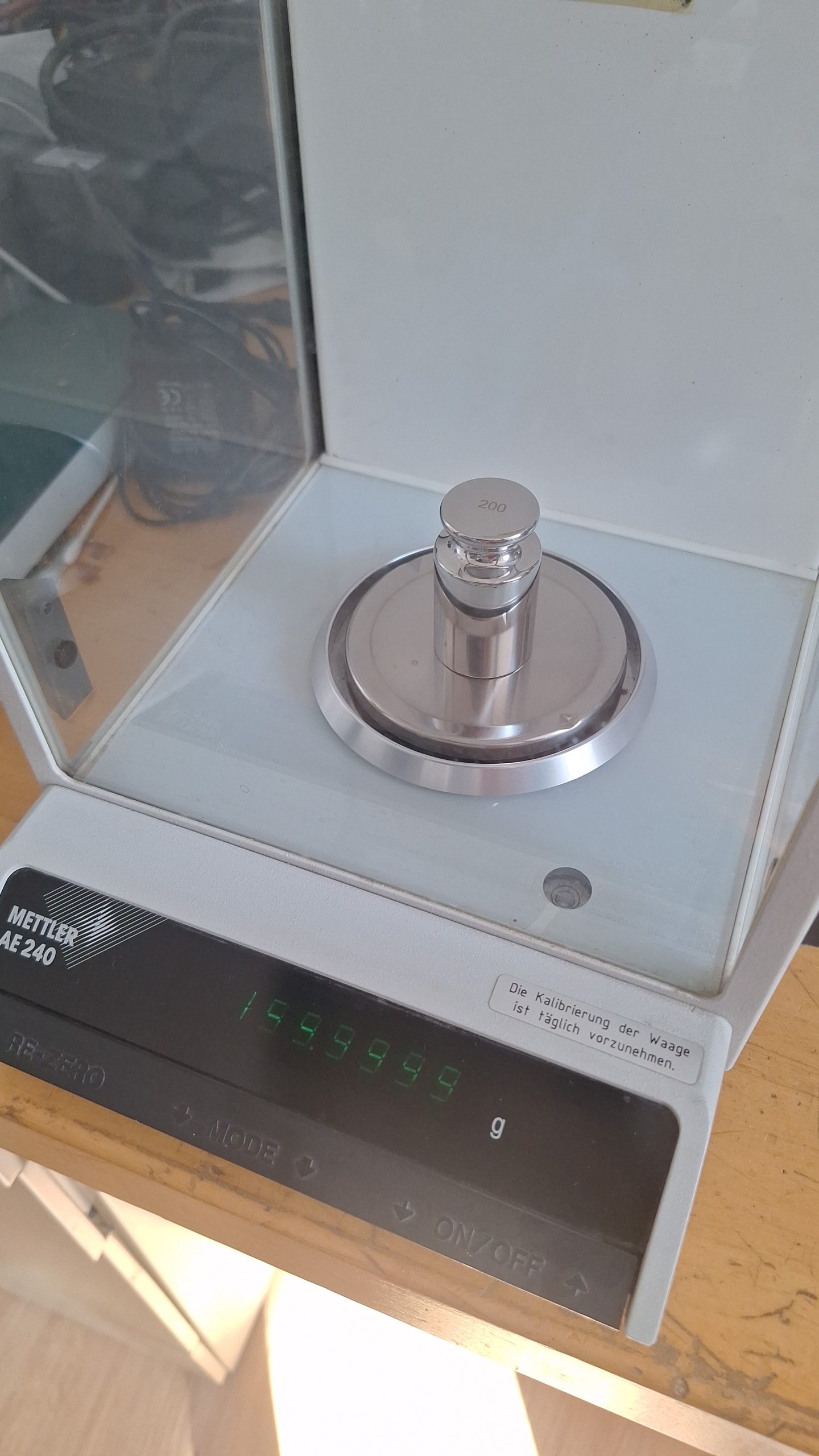
Recently my workshop has become a repair shop for historic balances (more about these later), and triggered by this activity I got a used Mettler AE240 balance. This AE series is probably one of the best balances you can buy, if you are looking of a analytical balance with 0.0001 g (0.1 mg) or even semi-micro 0.01 mg resolution. Having used these balances before, the AE is certainly my favorite, because of its mechanical quality and long-term stability. See also some earlier posts:
Mettler AE 163 Dual Range Analytical Balance: Swiss Made equipment, in Japan
Force compensating precision balance: a few very interesting, very rare schematics
Unlike modern equivalents, there is no software linearization or fancy load cell, but all is based on a solid mechanical design, careful study of the thermal effects, etc., the pinnacle of Mettler engineering. Furthermore, it is fairly easy to repair it, there are schematics available, and the components that fail are mostly the tantalum capacitors, but not the two proprietary Mettler ASICs.
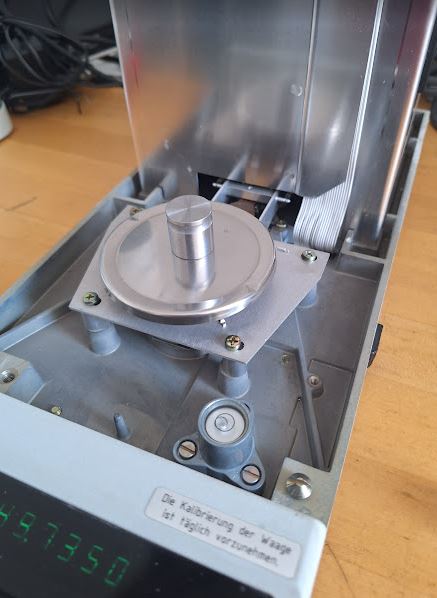
There is a 100 g calibration weight built-in, therefore the balance can be easily checked without any need to handle precision weights.
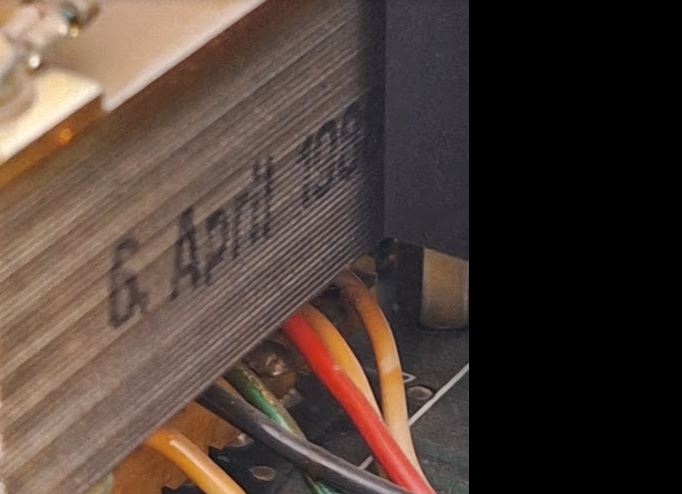
There is a marking on the transformer, year 1988 – nearly 40 years old.
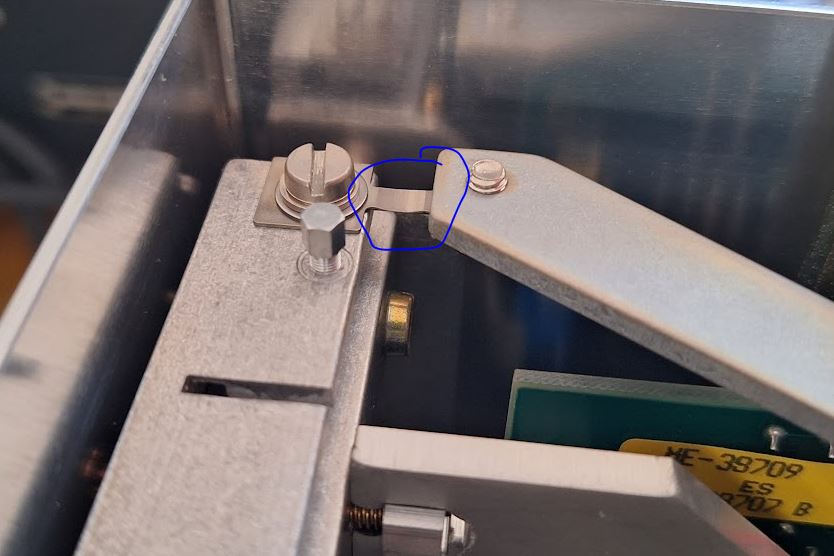
One key element of these balances are the hinges, machined (maybe by EDM or similar?) from sheet metal. Several of these – of identical design – are used in the AE balances.
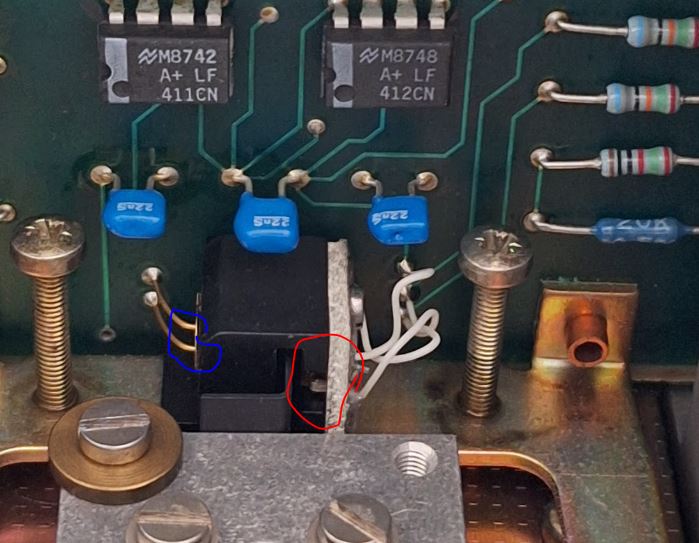
Another key assembly is the light gate position sensor. Using an IR emitter, left (SFH401-II), and a differential photodiode BPX48, right.
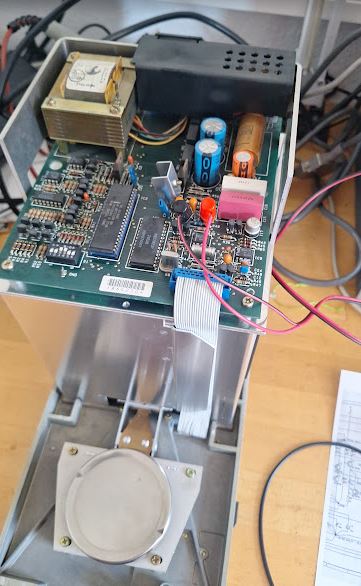
Following the explanations in earlier posts, there is a force compensation system working such that the load added is compensated by the electromagnetic force of a coil in a magnet. The current through the coil is proportional to the load. Firstly, I checked the current through the relevant resistor R49, a 390 Ohms value resistor, and the current is roughly 20 mA at full load (200 g).
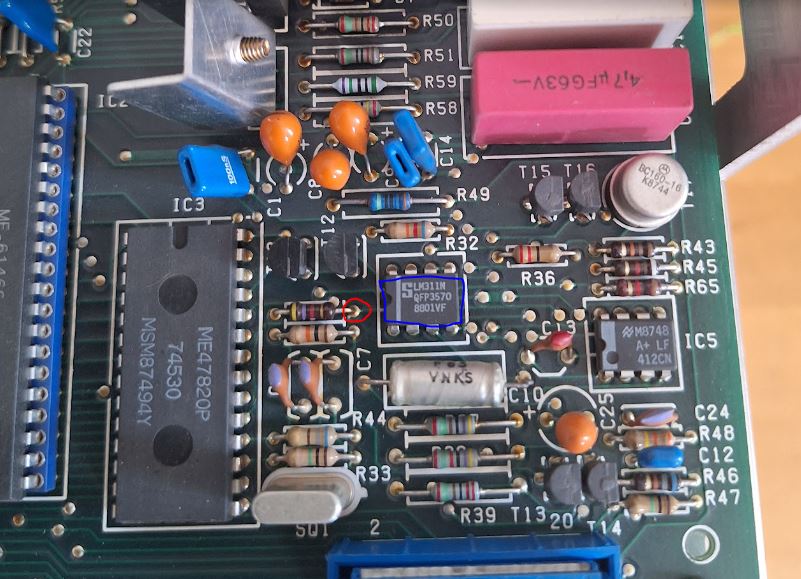
Rather than measuring the current by a voltage drop, Mettler design a fairly ingenious way to sum currents of the coil, of the temperature compensation circuit and from a precision current source in on node (which is kept at GND), feeding it to an integrator capacitor. The integrator voltage is compare to a rather fast ramp of ~1.638 ms period. Eventually, the precision current source on-time is proportional to the weight applied. There is a comparator, LM311, and the output has a convenient test point at the pull-up resistor.
I connected a highly precise counter to it, to measure the pulse width with various weights applied.
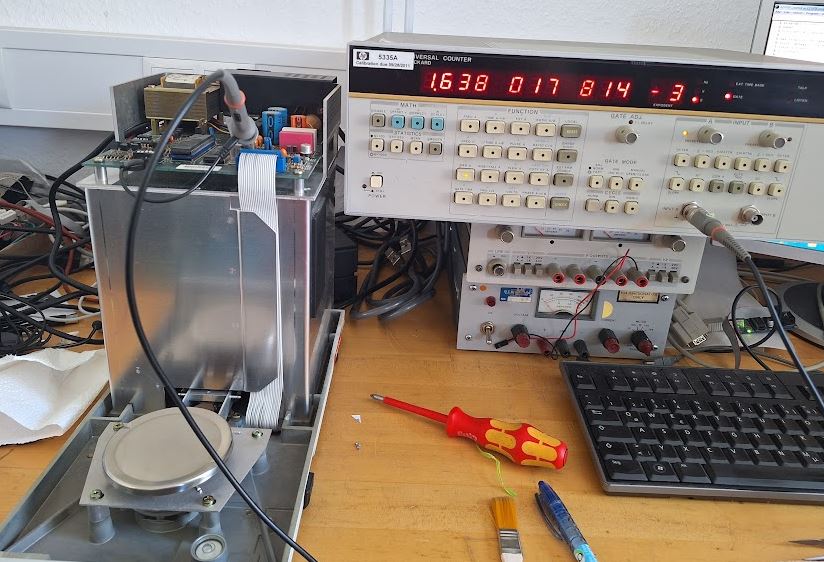
The pulse width test proceeding….
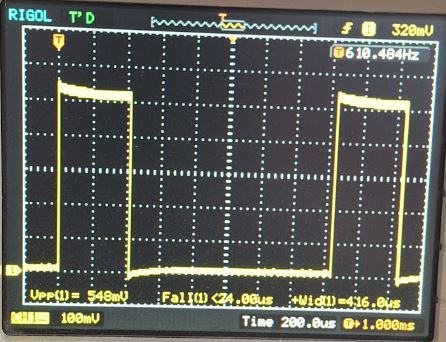
With 50 g applied, the on time is about 1/4.
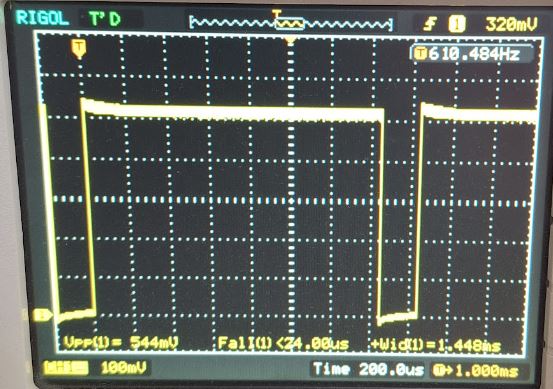
At 200 g applied, the precision current source needs to be on most of the time, to keep the time-averaged voltage of the integrator stable (keep the capacitor, on average, at constant charge).
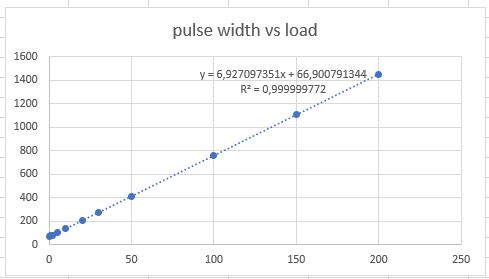
Some measured data – note that these were not taken with outmost precision, but just single cycle measurement. We would have to measure averages over several seconds for ultimate precision.
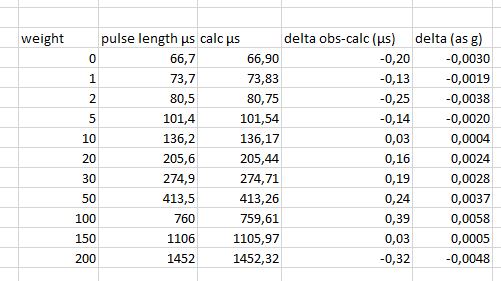
In any case, the tests showed the strict linearity of on-time of the comparator output with the load applied.
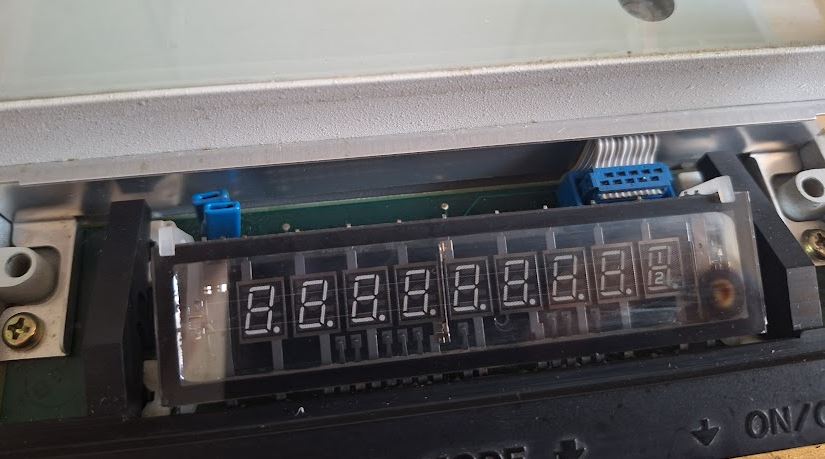
Having now understood the inner workings of the marvel to a larger degree, a small issue is the dim display. Over 20 years back, when working in the US, I had balance serviced, and remember that at that time, the service center also replaced the display. The AE series uses a vacuum-fluorescent display, called VFD in short. Surely we could replace the VFD by a LED display or similar, the signals would be easy to process, but better to keep all original and search for a replacement.
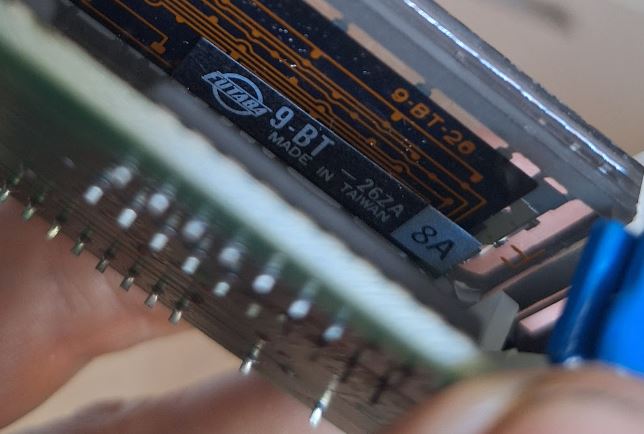
Checking the part, it is a Futaba 9-BT series 26ZA display. Futaba is no longer manufacturing displays, so the only chance are new-old-stock parts.
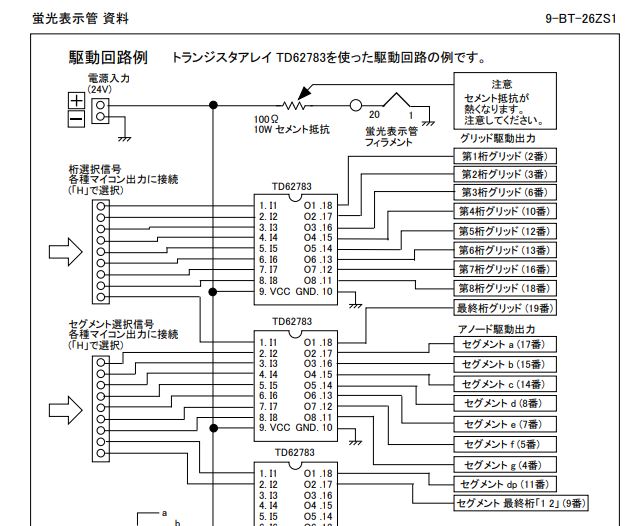
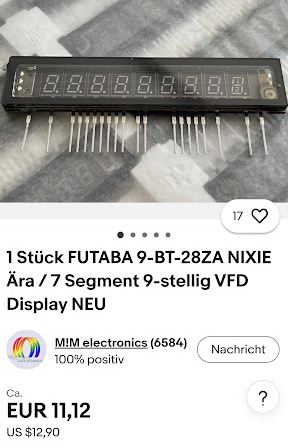
Looking around I found some really nice parts, 9-BT-28ZA. Comparing the pinouts precisely, the 28ZA display resembles the 26ZA. There appear to be some differences in the filament voltage, but these can be easily compensated by either a regulator or a resistor (will check once received).
To have some stock, ordered two pieces from the seller, who resides in Bulgaria (!) – let’s hope the package doesn’t get lost.