Tag Archives: thermal fuse

L33 Thermal fuse: inner workings

Recently, I had a project that required a reliable thermal fuse. There was little space to accommodate the classical axial versions, so I did some investigations and settled for the L33 type fuses. These come in various temperature versions, here, the 130°C limit, rated 2 Amps, 250 Volts.
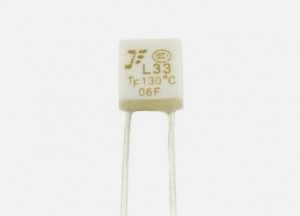
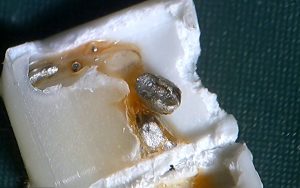
The main components are the 2 wires, a plastic case, and some resin. Having never studied one open, I disassembled a few good ones.
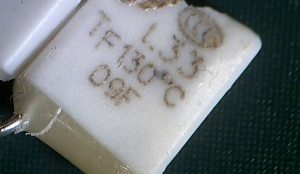
Clearly, the resin is filled to certain level. At the top, there is a bridge between the wires, made by low-temperature melting alloy (having tin, bismuth, indium and related metals).
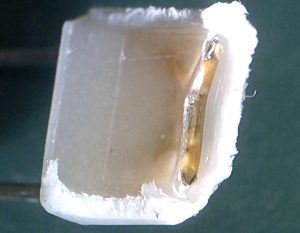
The alloy is quite substantial, likely to be able to handle 2 Amps of current.
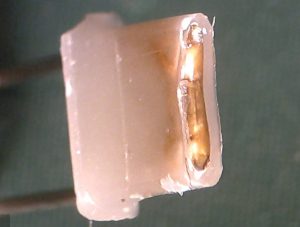
Triggering it with heat gun, the alloy melts, and there is enough space in plastic case that it forms a drop, effectively interrupting the circuit.

While the devices studied showed very good consistency of construction, a little overfilling with resin may result in the thermal fuse not opening, I hope the manufacturer has this parameter under strict control. For the 10 pieces I have, the weights measured on a precision balance where quite uniform at least. But if you get such critical parts from some doubtful sources, better you do some tests first and be sure they are reliable.
A Thermal Fuse, and HP 10811-60111 Repair

Usually, I don’t care much about high precision oscillator options being fitted to frequency counters, etc., because in the lab, any critical equipment is anyway connected to an external well-controlled 10 MHz reference, locked to DCF77. However, this time I need to install a OCXO (HP 10811) in a HP 5335A counter for service outside of the lab.

The only thing that needs to be done is to remove a jumper on the board of the 5335A (see red box in picture below), and mount the 10811 in the slot already prepared for the OCXO inside.

ocxo 5335a jumper

While such installation is fairly straightforward, it turned out to take more time than expected – simply because of the OCXO not showing any stable output signal.

ocxo 10811-60111

After a few quick tests, the cuprit was found, a defective (open) thermal fuse. This is apparently a quite common issue for the 10811 oscillators, and you might get away with just putting in a wire jumper. However, I didn’t want to take any risk of overheating in case of a failure of the 25+ years old OCXO circuits. An exact match for the thermal fuse could not be found, so just soldered in (very carefully, cooling the case and leads!) a 10 Amp 109 degC fuse.

ocxo fuse picture

This is the OCXO with the new fuse installed.

ocxo new thermal fuse

This style of fuse as a non-insulated outer shell, so a shrink tubing sleve serves as insulation.

ocxo insul sleve

Finally, a note found in a datasheet of a common thermal fuse – it clearly states that lifetime will be limited when operating the fuse to close to the cut-off temperature. So clearly, thermal fuses are not the best protective mechanism for the OCXO case. Maybe better would be a bimetallic switch (self-resetting, but at least no subject to any significant aging), or some other device like a PTC.

Sure, we can slightly blame the HP engineers, because it is stated on most thermal fuse datasheets, like the one below, that the operation temp limit should be about 30 degC less than the cut-off, which is not quite the case for the 10811 OCXO. 80 to 84 deg C operation, 109 degC fuse cut-off.

ocxo storage temp

ocxo thermal fuse