Category Archives: Test Equipment Repairs

For some, it is like solving crossword puzzles: fixing defective test equipment. Preferably, mid-70 to early 90s vintage.

HP 4191A Impedance Analyzer: 1-1000 MHz

Recently, I found a defective HP 4191A for a low price, and thought I should try to fix it – these devices where manufactured by HP’s Japan division, and for years, I have been looking for a working unit, but to no avail (prices in the range of 2-4 kEUR, and new instruments of this class demanding well over 10 kEUR). So, let’s see if we can fix this box.

This is how it should look like, from the cover of the HP Journal.

This is the unit currently, already opened it up to have a look inside.

Top view – a good amount of empty space, which is there to fit the high frequency resolution option.

The CPU boards, it seems to be the newer version, compared to the boards described in the service manual.

Rear view – this also carries the power supply (voltage regular A23 assy). Already removed it, it was only held on by two screws. As it turns out, it is not working, the 12 V rails are missing. And some other voltages are not good (5 V is fine, so the CPU is working and seems undamaged).

The unit is reasonably clean, but the power supply, it is dirty, and rusted. Not sure why.

Especially the opamps have signs of corrosion – two had even non-conductive, fully rusted legs. These are 1826-0043, which is a pretty generic HP part and can be replace by LM307H (or the DIP version, much lower cost, LM307N).

I have never seen such rusted opamps, maybe the instrument (or at least this assembly – the rest of circuits has no sign of rust) was kept close to the ocean, in salt spray?

After more careful analysis, some trouble with the 12 V (positive and negative) pass transistors.

Seems someone tried to repair it before, but for some reason, judging by the date codes, didn’t replace them.

The NPN, no problem, it can be replaced by a 2N3055. But the PNP – it is HP 1853-0252, alias SJ1798. Not sure how to get one of these.

With some further analysis of the maximum current, and other parts of the circuit, I believe we can safely replace it by a very common and low cost MJ2955. This is the complementary TO-3 transistor to the famous 2N3055, and by all I can tell, it should work just find in this power supply, as a simple pass transistor.

In the meantime, the board has been soaked in some isopropanol, and brushed with a soft brush, and all the rusted opamps removed. Ready for the new parts to be soldered in, once they arrive.

Another thing to look at – the NiCd batteries aren’t good any more. These will be removed or replaced, once the other parts are working, mainly to avoid any future risk of leakage of these cells, messing up the instrument.

Anritsu MG3681A Digital Modulation Signal Generator: a digital box

Along my search for used&broken&cheap test equipment in Japan I came across a Anritsu MG3681A 3 GHz generator, it has quite impressive specs, and the unit offered had the full CDMA-W digital package, allowing a whole lot of experiments with digital modulation. The price was right (just about EUR 100 plus shipping!), so this was soon to become the the first Anritsu gear in my workshop.

The information from the seller – at least it powers on, and frequency is locked. The unit also has the Option 02 OCXO, a really high quality 10 MHz source, so even if all the machine is defective and broken, there is still good use for it, just using the parts for other projects.

Further tests confirmed that the output is low, albeit, it is locked and even the ALC (level control) appears to be working.

Without having a good insight into the workings of this unit, also because of lacking schematics and details, I decided to do some tests. After removing about 100 screws or more (the unit has double and tripple shielding to avoid RF leakage), I got access to the attenuator and signals going to the attenuator (see block diagram). Obviously, something is wrong with either the attenuator (a burned segment or reverse power protection element introducing loss?) or the detector, or the ALC circuit itself.

Checking the diagnostic messages – the MG3681A thinks all is good! The only strange thing is that I don’t get any ALC error message (unleveled message, even when dialing in +17 dBm output, which corresponds to about 12 dBm output at present).

A through check of the attenuator shows that it is working in 1 dB steps – i.e., the MG3561A is only using a 1 dB for linear adjustment of power, and all the other attenuation is by the switched/mechanical attenuator. This true up to +5 dB, above 5 dB, the attenuator is set to 0 dB and the gain of the output amp is determining the power. Same below -135 dBm. Attached detail from the service manual shows the detail.

After all, I was able to confirm good working condition of the attenuator.

Next, some tests of the output level of the RF amp assy, which feeds the attenuator. And, not surprisingly, the output power is already low before entering the attenuator. All is leveled and working as it should, and also flat regulation with frequency (!), but too low power.

Following the service manual, there is a complicated procedure for output power adjustment. It requires some special software, and two more Advantek instruments that are hard to come buy, and actually, we don’t have any issue with flatness or response, but just an offset of the level. So we should be able to correct this somewhere in the analog circuit, say, in the opamp doing the ALC control, or in the DAC setting the output level.

Studying the circuit a bit, with the block diagram, and some general knowledge about such analyzer. The function blocks are clear. And a quick test showed that the level detector itself is working. So we need to troubleshoot the level control loop and opamp. Another interesting observation – the digital control of the final amp is actually done by light beams (IR diode sending, IR receiver), to transmit digital information noise-free to the final amplifier. Note the gaps in the cover, marked in the yellow circle. That’s where the light passes from the digital control to the amplifier section.

This level control circuitry is part of the modulation assembly, which is a fairly complex assembly. But, what is this? There are several micro-size adjustment pots. Could it be that one of the relates to the ALC loop? How can we find out? Easy enough, we monitor the output with a power meter, and turn each of the pots a bit, of course, not without clearly noting its original position. The 3rd adjustment pot – it does affect the output power! And, surprisingly, I can easily increase the power by about 6 dB.

With this adjustment identified (I could not find any reference in the service manual to these adjustments), I rechecked and readjusted it output power at a range of frequencies from 1 MHz, 10 MHz up to 3 GHz, and flatness is in fact very good! Also, I get the expected performance now when increasing the output power past about +14 dBm – an uncal-unleveled message is coming up, indicating that the maximum output power has been reached (the MG3681A can provide about 14-15 dBm leveled power over the full range).

A good amount of logic in programmable devices (firmware of MG3681A can be updated, if you have any such firmware, please share with we!).

Another view of the inside of the instrument – it is what I call the Japanese test equipment design, a lot of empty space, all well arranged, and many different types of assemblies and hardware with great attention to detail and sophistication, and some manual corrections with superfine wire. Because of such design, it also needs two fans – one for the power supply, and one for the main unit.

The CDMA-W functionality. Fully working at least as much as I can tell from spectral analysis of the digitally modulated signal.

Some study of the phase noise performance. The MG3681 is not too bad, it has fairly low SSB noise, even close to the carrier.

For comparison, the phase noise of a 8642B, which is a good HP generator, not the best for close in phase noise, but it is a low noise and heavy and sophisticated machine, even without any digital modulation.

No sophisticated phase noise test gear set up here, but let’s study it on a 8561B analyzer, at 2 GHz frequency. At 100 kHz span, the noise of the analyzer dominates, and both the 8642B and MG3681A show very much the same levels.

MG3681A:

HP8642B:

Close in, at 10 kHz, the MG3681A appears superior, maybe, by about 10 dB. Not bad!

MG3681A:

HP8642B:

With all the functions established again – some clean up: removed all the dust, checked all the connectors, and put the thing back together.

Now, all is hidden again under several sheets of metals, and all the many screws (not only many pieces, but also many kinds) back in. Let’s hope we don’t need to open it soon again!

Some useful documents:

Anritsu MG3681A Technical Description

Anritsu MG3681A Service Manual

Anritsu MG3681A Datasheet

The 08662-60001 low noise VCO: the heart of the HP 8662A

This is certainly one of the electronic antiques and marvels, which had the most hidden and non-spectacular impact on mankind and development of mobile communications in the 80s and 90s – the VCO of the 8662A/8663A, the defacto standard for low close-in phase noise signal generators.

The concept, it is a switch reactance oscillator, i.e., the inductances will be switched, to cover the 320 to 640 MHz range, rather than doing this all by varactor diode tuning.

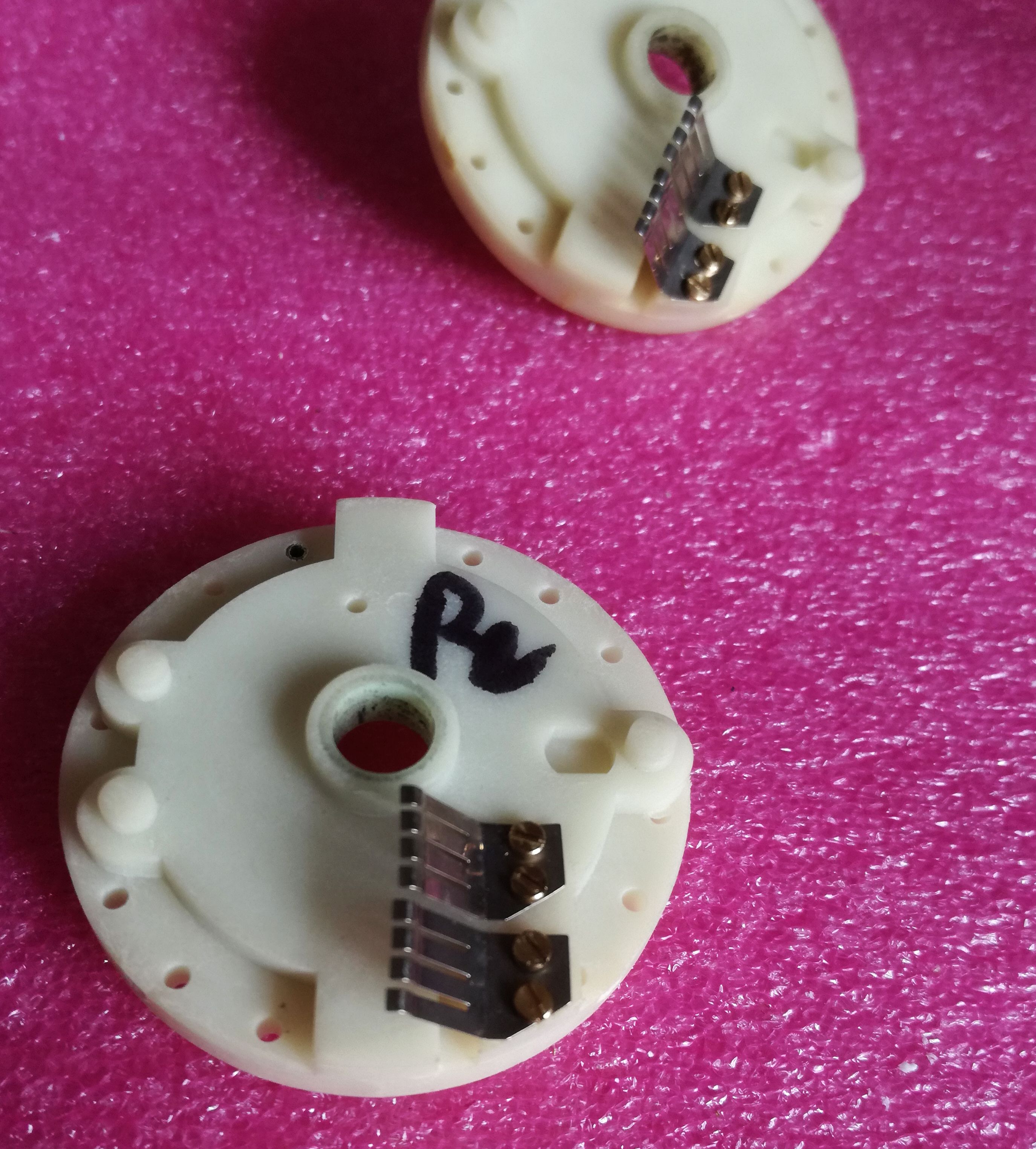
For low phase noise, you need an oscillator with high Q – this is achieved by strongly biasing the varactor diode over the full tuning range, and by low resistance PIN diodes (two in parallel, see below!), that switch the thin-film inductances embedded between lexane disks.

Note the small indent on the golden patch on the PCB? This is where the copper bolt reaches in to adjust the frequency offset.

All this is housed in extruded aluminum, end a layer of special steel which absorbs magnetic fields. So far, I never had the chance to look inside of these – but a kind reader this block, Martin, shared this picture and I put it up here for those interested.

The designer of this marvelous and magic device, his name, Dieter Scherer, a German fellow of HP, unfortunately, I have never met him and don’t know if he is still alive. Sure he left behind great achievement and a legacy of high frequency engineering.

Micro-Tel SG-811 Signal Generator: a second unit

By luck and coincidence, I found another Micro-tel SG-811 generator on eBay, at a very reasonable price – sold as not working. Even non-working, these units are great because of the many microwave components contained: YIGs, filters, GHz-capable relais, SMA cables… and a lot of old-fashioned analog circuits.

First check – the fuse! Someone recklessly put a 10 Amp fuse in, because the smaller fuses would blow. That’s never a good idea. Most probably we will have to deal with a power supply repair.

After detail assessment – the 24 V tantalum cap is shorted, maybe this triggered a sequence of faults: the main primary transistors (MJ12002), the rectifier, and two thermistors that limit the inrush current.

Micro-tel didnt safe on screws when they designed the power supply!!

These power thermistors are hard to get – I just desoldered two similar ones from old switchmode power supplies.

A dead rectifier – easily fixed.

All the parts labeled – also replaced the 2N2222 driver transistors, and two tantalum caps that were leaking current.

The most precious parts – the RF section.

A most complicated arrangement of oscillators, switches, couplers, and so on

Some of the oscillators originally used in these units required a variable supply voltage to get stable power output, but strangely enough, the YIG oscillators fitted have built-in voltage regulators, and the supply voltage has no effect at all on their output. Still, the power supply board caused issues – end even overheated, because the voltage is set by very sensitive trimmers, and drifted above 18 Volt…

The YTO has a voltage protection diode – it was completely fried when I received the unit. Checked some good Advantek YTOs, these have 18 V 1.3 W Zeners for voltage protection.

With power back on, and the voltage at the YTOs OK, still no good output – how can it be? Some issues with the oscillator driver board that sets the current of the main coil, and without a proper magnetic field, there won’t be any oscillation.

The precision resistors, seems they were hand soldered with some bad solder (traces of corrosion, and high melting point).

First, some trouble to find the dead part – thought it is one of the opamps, LM308, replaced it with a OP02. But no luck.

So I changed it back to the old LM308, just to keep all in original state.

The bad guy… a 4051 multiplexer CMOS, these are notorious!

Another interesting assembly, the reference assy – the 1N 827 reference diodes where still very accurately set, only a few ppm of the 11.000 V, and -11.000 V!

After these repairs, and some adjustment, all is back to working condition!

Checking out the signal on a 8566B analyzer. All good!

The pulse generator, also a great feature of this unit… 1 ms pulse.

down to 1 microsecond, no problem.

… 10 microsecond pulse…

The attenuator, a really high quality HP device.

The manual has some remarkable comments – use a 2 kbyte memory, just in case a “really big program” would be needed in the future.

Still, I will do some alignment of the oscillators and filters… but that’s no big deal.

HP 3580A Spectrum Analyzer: Digital display fix, and ancient CMOS circuits

With most of the 3580A functions working again, we still need to fix the digital display. Essentially, the 3580A uses a digital scope circuit, similar to those use in digital oscilloscopes of the 70s.

First, some study of the ADC. The 1973 HP Journal has all the details, it is successive approximation, peak detecting ADC.

Checking the input to the digital display board, blue trace, and the comparator/approximator input to the ADC, yellow. Seems something is wrong with the ADC ciruit, or it’s timing-counter control systems.

After considerable checking and probing, I found the issue, a dead 4019 CMOS, 4×2 multiplexer. Replaced it with a “new” part, taking great care to avoid any static discharge to the board.

The dead part, it is almost a historic piece! 1974, only a few year after the introduction of CMOS circuits by RCA!

That’s the full board. Multiplayer construction. Plenty of precision resistors that are needed for the ADC circuit.

Another working antique part – the 2102 S-RAM, Intel, 1 kbit per circuit. 8 pieces – a total of 1 kbyte of SRAM!

Working display…

10 kHz reference display… Great!

Even the log scale scan is working.

One tip – put all the screws and parts in a box, and check that it is empty afterwards. So many instrumented I receive here in the workshop are missing some screws or other parts.

HP 3580A Spectrum Analyzer: a few mechanical repairs, and sweep test

With the basic functions of the 3580A restored (at least, it is sweeping again), some attention needs to be paid to the mechanics. Fortunately, all is good with the intricate tuning assembly and digital display, but the knobs have some cracks, probably, a combination of age and stress.

Everything taped up, and the cracks filled with rapid-set epoxy resin.

To apply the resin to the small cracks, you can use a piece of stiff plastic foil, cut to a tool of appropriate size –

Here, a few close-ups of the tuning mechanism. It has fast tuning, and fine tuning, a clutch, several gears – all good old analog technology.

Finally, some test of the sweep circuit – but how to test a 200 second per division (i.e. 2000 second per screen) deflection for accuracy and linearity? Well, I connected it to a 34401a multimeter, and recorded the values for several hours by GPIB interface.

As you can see, the sweep is very linear, only some minor deviation at low voltages (maybe connected to some offset voltages or similar effects of the operational amplifier), at least, we can’t see any leakage current of the capacitor, which would show up as increasing sweep time with higher voltage/later divisions.

Also interesting, see the accuracy of the sweep speed, with warm-up of the instrument (each measurement is 2000 second). Still, after all these years, well within the 5% specification of the sweep time! Amazing!

HP 3580A Spectrum Analyzer: a non-working marvel of engineering

The 3580A is a audio spectrum analyzer of the 1970s, and not only useful for audio, but anything that can be converted to audio frequencies (e.g., noise analysis of GHz sources, provided, you use the appropriate mixers). This marvel is not a FFT machine, but a discrete audio “received”, using a low-noise local oscillator, and covering a frequency range from 5 Hz to 50 kHz. The resolution filters are quarz filters, with bandwidth down to 1 Hz! Dynamic range is over 80 dB.

The device, it comes from my old university, and has been sitting there on the shelf for a while, not working. And in fact, it shows not many signs of life, it is not sweeping properly, and even in manual mode, it is not working reliably (not showing any reasonable signal, but there is some activity on the tracking output which suggests that the instrument is not all dead, also the “overrange” LED is working).

After some study and test it became clear the the issue is with the ramp generator. Unfortunately, it is not a simple ramp generator, as you can see below.

The main circuit is a capacitor being charged by a current source (mechanical switch with resistors).

The voltage at the main capacitor, a 10 µF polyester hermetic cap (really high end with glass seal and metal case), is charged and its voltage amplified by a FET-opamp (the FET input constructed from a discrete FET pair, and a PTFE stand-off to keep this all really high impedance).

All the sweeting action is controlled by a state controller, more or less, a hardwired program with several TTL chips. It took me quite some study to understand how it is supposed to work. But fact is, it doesn’t. Clearly, the issue is with the A3 assembly. This must have been quit an expensive assembly at the time, with all the FET pairs and opamps. Still today, not an easy thing to fix.

At least, it is a beautifully arranged board, all gold plated and really smells like quality. So it is worth some time and effort to fix it.

Key for such repair, at least in any reasonable time, are a set of good schematics. Fortunately, I have a set around and printed out really large copies – it is worth the effort, because without making some notes, you will struggle to keep all in your brain and still work on the circuit.

With no extender board available, just soldered some wires to the board to monitor the state of the main state counter, and some of its inputs.

Hmmm, after a lot of probing, I was almost tempted to replace a good part of the TTL chips, because it is really hard to find the defect in such a complicated and loop-wired logic circuit, including its analog parts.

But after a bit more consideration and test, I decided to try a step-wise approach, starting from the most likely parts causing issues. One of the 7473 dead, no problem, there are spares around. But the next one – a 7472! This is an AND gated J-K flip flop, with three inputs to each AND gate… in simple words, something old, exotic, and rarely used. Went through all my piles of old boards and ICs, but no 7472 to be found! Quickly arranged a temporary 7472 – from a 7411 3-input AND gate and a 7473 flip-flop.

To be sure, I tested to old 7472 – indeed, it is not working.

With the A3 board temporary fix, a quick test of the unit.

Unfortunately, still some issues, but is is sweeping:

Display issue:

Check with a X-Y scope (on the rear outputs of the 3580A) – all seems good from the analyzer section, maybe some issue with the storage display?

Finally, on xbay, found a set of 5 pcs 7472 at a reasonable price, from Spain! NOS (=new old stock), about the same age as the 3580a!

Some fluxing issue with the soldering of the old ICs (clearly seen at the 7473), beware! Use some good flux, or solder from both sides.

HP 8659B Spectrum Analyzer: mostly, the known issues

Mostly, the well-known issues for this 8569B: a bad fan, a bad 5.2 V supply capacitor (see the 5.2 V rail ripple below!), some issues with the display adjustment, and a bad control assembly with contact broken off. The control assembly, interestingly enough, somebody else had fixed some part of it before, from the handwriting, an American.
Still some minor issues with the Z axis control (brightness control), but this will be fixed soon, and then the analyzer will be thoroughly tested and will find good use again.

Meridian 506 CD Player: a hot driver

This report is about a really high-end (made in UK) compact disc player – a Meridian 506.
It had some issues with the drive circuit, with the TDA2030 running hot, and sometimes not reacting to the front panel control.

The drive mechanics, it is a quite simple setup – a DC motor with pulley arrangement, and rubber ring.

The cooling plate – just a small piece of metal. Running all good when when the CD compartment is opened and closed quickly, but there will be issues if for some reason the CD deck is not closing quickly – motor switch-off is controlled by the end switches.

The main driver is TDA2030, and an additional issue is the closeness of the heatsink to the metal case. Just some Kapton tape, which had some damage already. Maybe making contact at times (tab is connected to Pin 3, VS-).

Added a big heatsink the TDA2030, which is now also well-insulated from the case.

All working fine again!

The TDA2030 – it’s not a motor driver, but an audio amplifier by design. But essentially, it is a high power opamp, so it can be handy to control motors, coils, etc.

I also made use of the opportunity, please see the zip file.

meridian cd player 506 firmware

You can also find a collection of Meridian schematics in the manuals’ archive: Meridian Schematics, please request the password by email if you need access.

Auna AV2-CD508 HiFi Amplifier: start-up power supply repair

The Auna AV2-CD508 is a quite nice and affordable amplifier, the case is pretty solid, aluminum front, steel case, and the controls are all easy to operate.

It’s a “600 W” peak amplifier, but won’t take more than 80 Watts, so it is more likely a 2x 40 W amplifier – still, 40 Watts are a lot of sound power.

Unfortunately, this set reached my workshop for repair, symptom: it doesn’t switch on, no signs of any activity. After some measurements, the fault is found it the auxiliary 5 V power supply, this is always on, to power-up the main power supply and the rest of the circuit. The auxiliary supply is controlled by a SF5922S switchmode controller, SO-8. Unfortunately, this part is only available in China, and doesn’t seem to last anyway, so I removed the power supply control, and added some wires to an external supply.

… the external supply, a 5 V power supply. Also used it to measure the current. Turns out, the auxiliary supply only needs to provide some 100 mA of current, not a lot.

With the lab supply connected, and the Auna plugged in, it powers up OK and all working!!

That’s the amplifier board, solder side. The auxiliary pwr supply controller marked in red.

With such a device, better not lose too much time, and I decided to add a completely new 5 V supply, from a leftover 5 V power adaptor.

These are the main amplifiers – CD1875 aka LM1875. These are not bad, and can reach -60 to -70 dB distortion, and are generally known as reliable parts.

Some distortions measurement, at two power levels…

… not too bad!

Gain, it’s not quite flat, but OK for the purpose.

Finally, with the new power supply, the Auna has a second life, most likely, even longer than its first.